


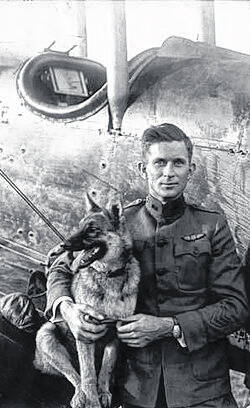
Belvin Maynard, a famous aviator from North Carolina known as “The Flying Parson,” was recently honored with a historical marker in his hometown of Harrells.
The unveiling ceremony of the marker was held Saturday at the Old Academy across from Harrells Christian Academy, which is just a stone’s throw away from where Maynard grew up on his family farm. The ceremony was attended by several descendants of the Maynard name, mostly through Maynard’s siblings. The marker honors Maynard and his contributions to the field of aviation while simultaneously acknowledging the pilot’s ties to the small town where he was raised.
Belvin Womble Maynard was born in 1892 in Morven, a small town in Anson County that is just a short drive away from the South Carolina state line. A few years later in 1905, Maynard and his family moved to a small farm in Harrells. According to the N.C. Department of Natural and Cultural Resources, Maynard displayed great skill in mechanics growing up, repairing equipment that regularly broke down on the farm. However, Maynard didn’t pursue mechanics or aviation as a serious career field just yet. Instead, he chose to pursue a career in ministry at just 15 years of age.
For his college education, Maynard chose to study theology at the Dell School in Delway. The school was later closed in 1923 and was added to the National Register of Historic Places in 1986. While some buildings of the school remain in Sampson County today, the main school building was demolished in the 2010s after it fell into disrepair. A few years into Maynard’s education, he slowly began operating as an ordained minister before both his career and education were put on hold due to the start of World War I. When America entered into the war, Maynard chose to leave school and enlist in the military, where he joined the U.S. Army Air Service and was deployed to France.
Here, Maynard put his mechanical skills to good use, assessing planes on whether or not they were ready for combat. Through this job, Maynard developed a deep passion for planes and aviation. When he came back to the States after the war in 1919, Maynard entered into a round-trip air race between Mineola, New York, and Toronto, Canada. Maynard would gain national attention for not only winning the race, but completing it in under eight hours. However, this was only the beginning for Maynard.
In October of that year, Maynard entered into one of the biggest aerial concepts of that time: the Transcontinental Aerial Derby. The derby required several pilots to fly from New York to San Francisco and back, stopping at 20 designated points along the way.
The derby has since become a major point in aviation history and is the focal point of author John Lancaster’s book, “The Great Air Race.” At the historical marker unveiling ceremony, Lancaster provided a historical presentation on the race. Lancaster, who happens to also be a pilot, flew the same route of the race to retrace the path of Maynard and the other pilots.
Any longtime resident of North Carolina can tell you that the state is “first in flight,” with the Wright Brothers making the first recorded flight in Kitty Hawk. However, according to Lancaster, American progress in aviation was growing only slowly, especially when compared to Europe.
“It’s really ironic that for the country that had the first flight, we really sort of dropped the ball,” said Lancaster. “There was very little support for aviation at the time. Meanwhile, European powers had been fighting since 1914 when we just entered in 1917. Because of that, they were leaps and bounds ahead of us.”
Maynard would become the winner of the race, completing it in nine days, four hours, and 25 minutes, setting a new world record. As a result of this feat that up until now had yet to be seen, aviation soon became the talk of the town for both North Carolina and the country. However, there were somewhat two sides to this. While some now clamored for progress in aviation, some people only saw the dangers of the race. During the race, eight people were killed as a result of crashes, weather related mishaps and technical difficulties. Even Maynard’s plane did not escape unscathed, sustaining a broken camshaft and a ruptured radiator. However, progress in American aviation continued nonetheless.
In December of that year, the first commercial airfield in North Carolina was built and named after Maynard in Winston-Salem. To show his appreciation, Maynard made the inaugural landing on the field. The field remained in operation until the mid-1930s and today a marker stands nearby, honoring the pilot and his contributions to aviation.
After the race, Maynard began testing his luck with his piloting skills, putting on aerial stunt performances to large crowds. As an ordained minister, Maynard would often combine aviation and ministry during his shows, earning him the nickname “The Flying Parson.” Stunts often included Maynard preaching sermons from the cockpit of his plane and even officiating weddings.
“Maynard was an especially cocky pilot,” said Lancaster. “Before the race, he wrote ‘Hello Frisco!’ on the side of his plane. Sort of a tongue in cheek way of saying he knew he was going to make it to San Francisco.”
Maynard’s luck would soon run out. In September of 1922 during an exhibition in Vermont, Maynard’s airplane stalled during a spin and quickly crashed to the ground. While Maynard’s passengers where killed on the impact of the crash, Maynard initially survived the impact. However, he would later succumb to his injuries while en route to a local hospital.
Maynard’s body was laid to rest in his family’s cemetery on their farm. The Maynard Family Cemetery is located just two miles west of the new marker. The installation of the marker makes the second historical marker in the state dedicated to the skilled pilot and his contributions to the field of aviation in the hopes that he will never be forgotten.
The trophy that Maynard received for winning the derby can now be seen at the National Space and Air Museum in Washington, D.C.