
A move proposed by the town of Fuquay-Varina could have devastating impacts on Sampson County, according to several county officials.
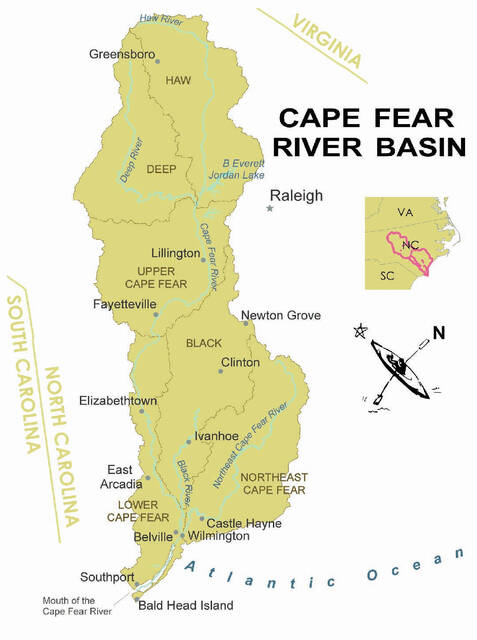
Fuquay-Varina has requested to transfer up to 6 million gallons per day from the Cape Fear River basin to the Neuse River basin in Wake County. According to fuquay-varina.org, “an interbasin transfer is defined as the regulated movement of surface water from one river basin to another. Law does not prohibit transfers, but requires that effects of the transfer on the source and receiving basins be quantified prior to the transfer.”
Chip Crumpler, who represents District 3 on the Sampson County Board of Commissioners has drafted a letter opposing the transfer to the NC Department of Environmental Quality (DEQ), and requested that the commissioners adopt a resolution of opposition at the Jan. 5 meeting. However, the commissioners requested more time to study the resolution, and will likely discuss it at their February meeting.
“I believe this issue is important for Sampson County for several reasons,” Crumpler explained. “First, Sampson County lies entirely within the Cape Fear River Basin, and portions of our public water system already rely indirectly on Cape Fear water through purchased supply. Decisions that permanently remove water from the basin have implications not only for downstream counties today, but also for our own long-term water security as population, economic development, and agricultural demands continue to grow.”
The transfer of water out of the Cape Fear River Basin could also negatively impact the county’s largest industry, agriculture. “Our agricultural economy depends heavily on reliable and adequate water resources from the Cape Fear River Basin,” wrote Sampson County Cooperative Extension Director Brad Hardison in a letter of opposition to DEQ. “Surface water and groundwater within this basin are critical for crop production, livestock operations, food processing and long-term farm viability. Any reduction in available water supply, whether immediate or cumulative over time, presents a serious risk to agricultural productivity, farm sustainability and the broader rural economy.”
In his letter, Hardison went on to assert that water is “not a surplus commodity” in Sampson County or in any of the other regions that would be affected by this interbasin transfer. “[Water] is a foundational resource that supports food production, economic stability and environmental health,” he wrote. “The loss or reallocation of water from this basin could have cascading and potentially catastrophic impacts on agriculture in Sampson County and surrounding counties that rely on the same watershed.”
Sampson County Economic Development Director Ray Jordan has also voiced his opposition to the proposed transfer. “Sampson County hosts a diverse array of industrial operations and is home to one of the strongest agricultural sectors in North Carolina,” he stated in his letter to DEQ. “These sectors rely on predictable water supply availability within the Cape Fear River Basin for operations, food processing, manufacturing, and livestock production.”
The county’s existing industrial facilities rely on high-volume, high-quality process water, he added, in addition to the future industries the county could attract. Jordan also detailed that a reduction in water availability could diminish the county’s ability to attract new capital investments, the development of potential of industrial sites and strategic infrastructure projects, and confidence from prospective companies evaluating long-term operational sustainability.
Crumpler contended that if the county commissioners go ahead and adopt a formal resolution now, it “would be a prudent, forward-looking step.”
“It places Sampson County on record in support of protecting the integrity of the Cape Fear River Basin, helps avoid future conflicts over limited water resources, and aligns us with other downstream communities that share these concerns,” he said. “This resolution is not directed at growth itself, but at ensuring that growth in one region does not create long-term constraints for another.”
The Fayetteville Public Works Commission, which serves the city of Fayetteville and Cumberland County, has already launched its own campaign to get the word out on the proposed interbasin transfer, titling the effort “Don’t Drain Our Future.”
NCDEQ is accepting written comments, which must be received by email or postmarked by April 1, 2026. Comments may be sent to: Maya Holcomb, Division of Water Resources, 512 N. Salisbury St., Raleigh, N.C. 27604; or by email at [email protected].