

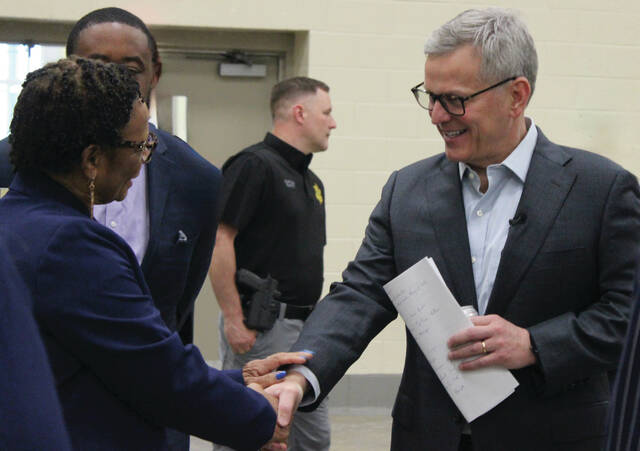



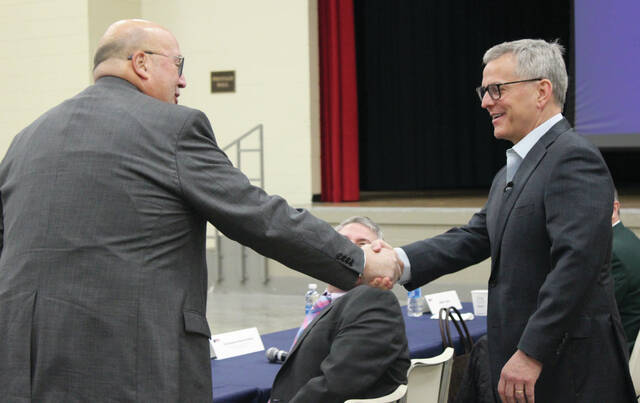


In something of a rarity for Sampson County, two top state government officials visited the area this week. On Monday, NC Superintendent of Public Instruction Maurice “Mo” Green toured Union Middle School, while on Wednesday, Governor Josh Stein made the second stop of his rural listening tour at the Agri-Expo Center in Clinton.
The rural listening sessions are part of the governor’s aim to reach all 100 counties in the state. “The governor and cabinet secretaries are embarking on this rural listening tour to hear directly from rural North Carolinians about their concerns and priorities as his administration works to expand opportunity in every corner of the state,” a press release from the governor’s office explains.
The tour started off March 16 in McDowell County.
Wednesday’s meeting included not only local officials from Sampson County, but also several from Duplin, Wayne and Brunswick counties.
Representing Sampson were: Dist. 4 County Commissioner Lethia Lee, County Manager Allen Vann, Capt. Marcus Smith from the Sampson County Sheriff’s Office, Sampson Regional Medical Center CEO Dr. Shawn Howerton, Sampson Community College President Dr. Bill Starling, Anne Faircloth of Lafayette Farms and NC Senator Brent Jackson. Dist. 5 Commissioner Thaddeus Godwin was also in attendance, but he was not on the panel to speak.
Notably absent from the listening session were the Republican county commissioners, Chair Allen McLamb, Vice Chair Eric Pope and Chip Crumpler, as well as Clinton City Schools Superintendent Dr. Wesley Johnson and Sampson County Schools Superintendent Dr. Jamie King. There were also not any representatives from the city of Clinton, nor from any other municipalities within the county, although Samantha Wullenwaber, executive director of the Mid-Carolina Regional Council, who often assists several Sampson County towns with various needs, was a member of the panel. In addition to former Farm Bureau president Larry Wooten, Wallace Mayor Pro Tem Francisco Rivas-Diaz was on hand, along with Duplin County Sheriff Stratton Stokes, Todd Walker, president and CEO of the Wayne County Chamber of Commerce, and Leland Councilwoman Veronica Carter.
“We’ve been really focused over the last 13, 14 months that we’ve been the administration,” Gov. Stein started off the meeting by stating. “We have many grant programs of different types, some of which are water/sewer, small town, downtown, revitalization, manufacturing facility revitalization. … Public schools, we know that it’s harder to recruit teachers in the rural world than it is in the more urban parts of the state, that we may see 20 percent turnover in rural county school systems, as opposed to 10 percent in an urban county system. We know that it’s hard for rural communities to supplement their tax base with some of the salaries that urban counties can.”
Stein also mentioned the importance of infrastructure, touting that his administration has recently approved about $300 million in broadband expansion projects, as well as water, sewer and wastewater improvements. Sampson County, in fact, is getting a $3 million grant to provide water services to the Old Warsaw Road community.
On the healthcare front, the governor acknowledged that outcomes are generally worse for rural residents, when compared to more urban areas. “We want to give you more money,” he said, pointing out that of North Carolina’s 720,000 rural residents, about 250,000 struggle to pay medical bills.
“Here in Sampson County, we have a lot of critical needs,” Lee told the governor. “We’re concerned mostly about the property tax, where that’s going. Nobody knows yet. But we know how critical that is to Sampson County because we know we don’t have the other things to make up the difference. We will be looking to the state to supplement us for the DSS, Health Department an other agencies here in Sampson County, because we don’t want any of our citizens to be in lack.”
Faircloth stated that she has some concerns about growth, especially seeing how other counties have not managed growth in the most productive ways. “We’re going to be rural,” she said. “We’re always going to be agricultural. I hope that’s part of our soul, but how do we make sure we guard that and still remain in movement toward all the growth that’s happening in our state?”
Vann, who became county manager last July, echoed some of those same points. “I agree with Mrs. Faircloth in that how do we honor our agricultural roots but then we also have to consider the growth that is eventually coming. We’re going to be pressed from every direction with metropolitan areas near the county.”
Having just started his first budget for the county, Vann shared that growth is nearly stagnant at this point, with property tax revenue accounting for about 60 percent of the county’s total revenue.
The governor posed the questions: “What are the barriers to economic growth? Is it that we need to figure out ways to help agriculture be more productive than it has been? Or are there ways that we can help agriculture deal with the incredible ups and downs they’ve experienced, whether it’s the tariffs or drought or other subjects?”
He praised Sen. Jackson for the work he has done in the General Assembly to help the county’s economy, despite the ups and downs, as he termed them.
Vann took the floor first, sharing that he and the county commissioners believe the county needs more diversity, rather than solely relying on agriculture. “What we’re faced with, you hit the nail on the head, obviously, as so many rural counties, is just not having the resources to do the infrastructure necessary.”
He shared that the commissioners hope to grow the industrial park in Newton Grove, but there are infrastructure needs that will probably total $25 million or more for a wastewater plant, and possibly $40 million to build the necessary roads.
Carter, the councilwoman from Leland, acknowledged that infrastructure is a big problem for rural communities statewide, even those in more affluent areas like Leland, which is near Brunswick and New Hanover beaches.
Wooten also wanted the governor to know that farmland preservation is a big issue for rural areas. “Development comes at a price for farmers,” he stated. “We are losing farmland faster than the national average in North Carolina. When you run water and sewer under a piece of farmland, ultimately, you have doomed that farm.”
The conversation then turned back to water and sewer needs. Lee pointed out that the district she represents in the southern end of the county, the population is mostly elderly and struggle to find clean water. “Everything I do is for this county; it’s not for me, it’s for the people that I serve,” she stated. “So that’s why I wanted this session to be held, so that you could come, and other legislators could come, and see what we’re dealing with.”
Though the local superintendents were not in attendance, Stein asked how the county’s K-12 schools were doing. Dr. Starling addressed the growing trend of preparing students for careers through community colleges. “North Carolina’s community colleges do a very good job of providing training for state certifications for plant expansions, which are all local responsibilities,” he said. “The problem with that in a county like Sampson and some of the other rural counties in the southeast is we don’t always have that growth. We are aware that we need to bring some of those opportunities to our service area, and we don’t have access to capital [to do that].”
He thanked Sen. Jackson for his help in garnering various funding sources to the community college, but, he said that the state legislature really needs to provide more money for education.
Dr. Howerton shared the hospital’s perspective, stating that it was difficult for Sampson Regional Medical Center to offer competitive salaries for physicians and other staff. “You’ve got to find doctors that want to work in a rural area, either live in a rural area or commute to a rural area, which is very much a challenge,” he said.
Vann agreed that the county government also faces challenges with not being able to provide higher salaries. “We have so much difficulty competing,” he said. “We don’t have the resources to pay what your Cumberlands, and your Johnsons, and some of these other counties are paying them. They’re able to make as much as $10,000-15,000 for a year for not very much of a commute.”
On the public safety side, Sheriff Stokes shared that the mental health system in North Carolina is broken. “It puts a lot of pressure on the local detention facilities, and there’s a lot of people who are in jail that shouldn’t be; they should be treated,” he explained, further stating that he would like to see some changes statewide.
Duplin, for instance, has to send its mental health patients to Ahoskie, which creates a lot of strain on deputies, who have to transport patients many miles.
Dr. Howerton reiterated that the Big Beautiful Bill took $150 billion from hospitals nationwide, leaving many rural hospitals in the lurch. “So, I would say just, as you’re looking at things, remember all hospitals are not the same,” he stated. “Rural hospitals need a different consideration, especially the last few of us.”
To close out the meeting, Stein stated, “I really appreciate everybody taking the time to share their ideas and thoughts. Me and the team have a lot to chew on, and we will.”
He added, “We’re all public-spirited people. I appreciate that passion. We’re all working together to form a better North Carolina.”