

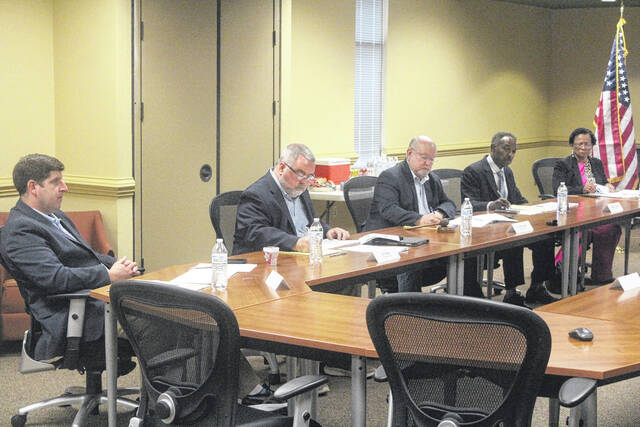
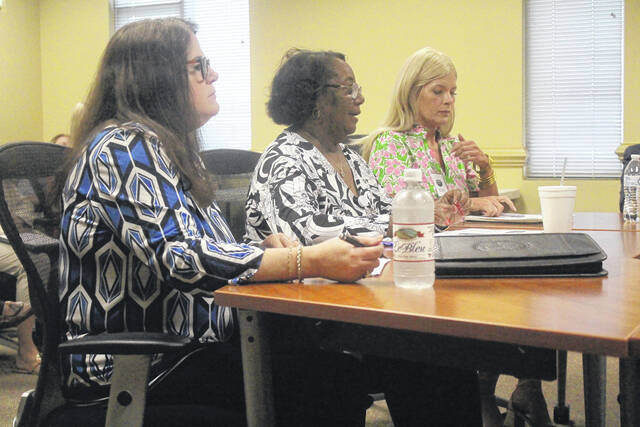
Staff vacancies, more than anything else, seemed to be at the root of budget discussions Monday between the Sampson County Board of Commissioners and leaders of DSS and the Health Department.
While discussing the current state of the department, Health Director Wanda Robinson let commissioners know that she currently has 41 positions filled, along with six vacant positions, one of which is empty due to military leave.
“This is a problem for us,” stressed Robinson . “I’ve had three or four people handling other programs in the department plus these to try and make sure we can meet our goals. That’s pretty much what we wanted. We wanted to show how we’ve been struggling this year and how it’s been affecting us as far as providing this many services and programs that we need to provide.”
According to Robinson, this previous year marks the first year in a long time that the department has had this problem. The six vacancies include, three intermediate level public health nurses in the communicable disease, maternal health and public health preparedness programs, an advanced practitioner, a public health nurse II and an environmental health specialist.
Additionally, Robinson cited the competitive nature of the career field and salaries as explanations for the recent vacancies this year.
“Even during COVID, our staff at the department stayed with us,” Robinson pointed out. “This is really the first year in a long time that it has been like this. To stay in public health, you have to love it. You have to have the spirit to work in this field, especially for nursing staff. If they’ve got that, they can really go anywhere. For example, we thought we had a nurse practitioner, we were getting ready to hire her and everything, then another place called her and offered her $10,000 (more). I cannot compete with that.”
During their presentation, local health officials provided commissioners with a breakdown of their payer sources, which include: 30 percent of the department’s budget comes from the county, 15 percent from insurance and patient pay, 17 percent from federal grants and programs and 38 percent from state funding.
According to the commissioners, the total Health Department budget, with all these factored in, comes to $5.1 million. However, as of now, only $3.1 million of that has been spent. Commissioner Houston “Chip” Crumpler III stated that based on this, by the end of the fiscal year, the Health Department would not have spent it’s total budgeted funds.
“If this continues, by the end of the year the Health Department would spend only about $3.7 million of the $5.1 million,” stressed Crumpler.
Robinson attributed the shortfall largely to the vacancies. She also explained that county funds can roll over to another year while state and federal funds have to be spent in the budget year.
“State funds do not roll over from year to year,” Robinson explained. “If you do not spend them this year, you may not get them back next year. We pull state funds first and most of the state funds are budgeted for salaries. A couple of months ago, we had to go back to the state and request to use some of the money for equipment, because we did not have the positions filled. We had to shift some things because we were not able to pull the money for the salaries.”
At the end of their presentation, Commissioners Chairman Allen McLamb thanked the Robinson and her staff for their presentation.
“We appreciate what all you do,” said McLamb. “We know that you are understaffed and you’re not really sure what each day is like. You’ve given us something we can really look at and into.”
Another county department currently facing staffing issues is DSS. At the start of their presentation, Patty Santos, director of the department, acknowledged that this past year has been a difficult one, largely due to the department’s temporary staff.
According to Santos, years ago, the department decided to repurpose a number of their clerical positions, entry-level positions focusing primarily on managing records, filing, scheduling, answering phones, data entry, and using office software. Santos said that for roughly 10 years, the department has been abolishing and reclassifying some of these positions and filling them with part-time staff members.
Santos further explained that due to changes in labor laws this year, having part-time staff has become impossible.
“The actual number of full-time clerical staff is very, very slim,” said Santos. “This year, because of some changes with the Internal Revenue Service, we are no longer able to have part-time staff. Therefore, I do request that we have some additional staff to make up for these lost temporary workers.”
According to Santos, to make up for the lost positions, the department has narrowed it down to 13 full-time positions that the department has to fill. However, she noted that shewould be willing to work with commissioners to identify areas where the department could restructure to make up for the lost staff.
“We have identified some vacancies that we can reclassify in order to provide some support to the clerical unit,” said Santos. “We’re looking at the front desk window in the lobby and in the services lab. We’re also looking at putting in a kiosk to streamline checking in. Our goal is to be able to sustain until we’re not able to sustain anymore, and then we will be back.”
As for full-time workers, the department has a total of four vacancies. This includes two income maintenance Medicaid supervisors who oversee staff tasked with determining eligibility for Medicaid. One of these positions was later reclassified for the front desk position.
“It’s been vacant for some time,” said Santos. “It’s going to be very tricky to fill that one. The other one, we reclassified to the front desk to provide that support elsewhere. It’s a tough position to fill, but we have several staff in that department that need supervision.”
In addition to the supervisors, the department also lost two positions in the Foster Care department. Like Robinson, Santos also cited the competitive nature of the field’s workforce and salaries as a reason for the vacancies. In previous years, the department has had employees move from the Sampson County office to an office in Johnston County for better pay.
“It’s been happening in our social work department before, we lost two administrators previously and now it’s happening in the eligibility department,” Santos said. “We are encouraging the part-time staff that we are losing to apply for full-time positions. It mainly comes to salary, because the work is the work, and the work is hard. I think the mindset that a lot of people have is that, ‘If I’m doing the hard work, I might as well get compensated for it and take the longer drive.”
No decisions on a budget were made during the budget work session. The information given on the departments during the meeting will be factored in as the commissioners put together a final budget proposal. The next budget workshop for the county commissioners will be Monday, May 18 at 4 p.m.