

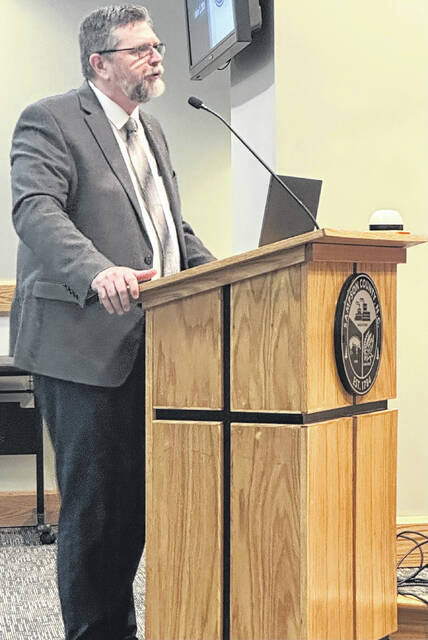
Sampson County Manager Allen Vann unveiled a proposed 2026-27 budget Monday that includes a 3 percent cost-of-living adjustment for county employees, employee bonuses, and continued investments in economic development, but no tax hike. Despite that, one commissioner publicly signaled opposition to future tax increases he envisions coming with the plan.
Presenting the proposed spending plan during Monday’s Sampson County Board of Commissioners meeting, Vann emphasized that the county continues to face increasing operational costs, employee recruitment challenges and infrastructure needs while attempting to remain competitive with neighboring counties.
His proposal, though not discussed with commissioners much in public, drops the recommended employee COLA from the 4 percent initially recommended in late April, although no discussion centered around the decrease.
Vann is also now recommending taking $1,788,649 (down from the April proposal of $2.38 million) from the county’s fund balance (or rainy day fund) to balance the general fund expenditures currently sitting at a proposed $85 million, a 2.6 percent increase from last fiscal year.
A public hearing will be held on June 15 at 6 p.m., offering residents an opportunity to ask questions and share their thoughts on the proposed fiscal plan. The budget could possibly be adopted if no public concerns are submitted. A final budget is expected to be voted on or before July 1.
Tax rate
comparisons
While the proposed budget does not include a property tax increase, Vann spent a considerable amount of time reviewing Sampson County’s tax rate and comparing it with surrounding counties and counties of similar size across the state. Vann cautioned commissioners and the public against making direct comparisons between counties based solely on tax rates.
“Most people compare property taxes, but not every county offers the same services,” Vann explained. “Some counties have vastly different revenue sources, some are on different revaluation schedules, and commissioners can change tax rates. There are a lot of factors that need to be considered when talking about tax rates.”
Using comparison data from similarly sized North Carolina counties, Vann noted that Sampson County’s current tax rate of 68.5 cents per $100 valuation is above the average among comparable counties, but he stressed that revaluation cycles significantly affect those figures.
According to county data presented Monday, the average tax rate among counties with populations similar to Sampson’s is approximately 56.4 cents per $100 valuation, while the average among surrounding counties is approximately 62 cents.
Vann also highlighted continued growth in the county’s tax base.
The county’s tax office projects a collection rate of 97.5 percent for fiscal year 2026-27, matching the previous year’s performance. County officials estimate the tax base grew by approximately $209 million over the past year due largely to residential and commercial construction.
The county’s overall tax base is now valued at roughly $7.43 billion, with total property tax revenue projected at approximately $50.4 million, an increase of nearly $2.37 million over the current fiscal year.
Vann also reminded commissioners that a six-cent property tax allocation approved by the board last year was intended to fund specific recurring needs annually.
Under that allocation:
• 3.5 cents supports public education, including school operating expenses, capital funding and Sampson Community College capital needs.
• 2 cents supports public safety, including annual replacement of ambulances and sheriff’s patrol vehicles.
• One-half cent supports county building maintenance and capital improvements.
According to county figures, the average single-family residence in Sampson County is valued at $142,861. At the current tax rate of 68.5 cents, that homeowner pays approximately $978.60 annually in county property taxes.
Employee recruitment
and retention
A major focus of the proposed budget is employee compensation.
Vann told commissioners that Sampson County continues to struggle to compete with surrounding counties for qualified workers, particularly in specialized positions.
“We know we don’t have the resources to compete with some larger counties,” Vann stressed. “But we also know we must position ourselves as competitively as possible. It’s important that we reward our outstanding staff who remain with us.”
County data showed neighboring governments have generally provided cost-of-living adjustments ranging from 2 to 4 percent in recent years, while Sampson County did not provide a COLA in the current budget cycle because of financial constraints.
Vann argued that turnover costs often exceed the cost of salary adjustments.
“The cost of employee turnover typically ranges from 50 percent to 150 percent of an employee’s annual salary to recruit, hire, train and replace that position,” he said. “There are also many hidden costs related to efficiency and customer service. Ultimately, you could end up spending considerably more than the cost of a COLA itself.”
The county continues to experience challenges retaining workers in positions such as nurses, social workers, paramedics and E-911 telecommunicators.
According to Vann, annual full-time employee departures averaged approximately 57 workers before the COVID-19 pandemic. Since then, the average has risen to nearly 79 employees annually.
County statistics also show that approximately 48 percent of full-time employees have less than five years of service.
To address those concerns, Vann recommended:
• A 3 percent cost-of-living adjustment for county employees.
• Two additional paid holidays, July 6 and Nov. 25.
• An additional floating holiday employees may use at their discretion.
The proposed 3 percent COLA carries a total cost of approximately $1.22 million, including just over $1 million from the county’s general fund.
The budget also proposes a one-time employee bonus in December. Under the proposal, full-time employees with at least one year of service would receive a $500 bonus. Regularly scheduled part-time employees would receive $250, while other eligible part-time employees would receive $100.
The total cost of the bonus program is estimated at $260,675.
Economic investment
Vann also outlined plans to continue expanding the county’s industrial footprint.
He said county leaders have made significant progress securing sites for future development, including the Sampson Southeast Business Center in Clinton and the U.S. Industrial Park in Newton Grove.
To accelerate recruitment efforts, county management is recommending construction of a speculative industrial shell building at the Sampson Southeast Business Center.
The proposed facility would contain approximately 70,000 square feet, which Vann said reflects the median building size most frequently requested by prospective industries.
“The reason we’re suggesting the Sampson Southeast Business Center is simply because the infrastructure is already there,” Vann explained. “It would allow us to get the project to market quicker and at less expense.”
The county also plans to continue engineering and infrastructure planning at the Newton Grove industrial park, including water and sewer extensions, roadway planning, stormwater systems and utility coordination.
To support those initiatives, the budget includes the first year’s debt service payment of $772,510 on a proposed $5 million, 10-year financing package.
Crumpler: County must
live within its means
Following the presentation, District 3 Commissioner Houston “Chip” Crumpler III praised county staff for their work but voiced concerns about the long-term sustainability of recurring spending increases.
Crumpler noted that budget discussions originally included a four percent cost-of-living adjustment before being reduced to the proposed three percent COLA and employee bonus package.
While acknowledging the county’s recruitment and retention challenges, Crumpler warned against allowing recurring expenditures to grow faster than recurring revenues.
“I believe it is important that we keep one fundamental principle in mind moving forward: growth in our recurring expenditures should not consistently outpace growth in our recurring revenues,” Crumpler attested.
He noted that earlier budget discussions included spending increases that would have exceeded natural revenue growth by more than $1 million and would have required the appropriation of more than $2 million from the county’s fund balance.
“As I stressed during last year’s budget discussions, we cannot, as a county, develop a habit of spending money faster than we make it, regardless of how important the services we provide may be,” Crumpler stated. “We simply cannot.”
Crumpler said many expenses facing local governments, including inflation, insurance costs and state and federal mandates, are beyond the board’s control. However, he argued county leaders must carefully manage the factors they can control.
“The taxpayers of Sampson County generate a finite amount of revenue each year,” he said. “The responsibility of county government is to provide the services we are required to provide, and the services we choose to provide, within those available resources whenever possible.”
Crumpler also made what he described as a personal policy declaration regarding future budgets.
“While I am only one member of this board, I do not intend to support another property tax rate increase during my service on the Board of Commissioners,” he asserted.
He called for greater efficiency, innovation and use of technology in county operations and encouraged department leaders to continually evaluate how services are delivered.
“My commitment is simple,” Crumpler added. “I will continue to support responsible government, essential public services and our county employees, but I will also continue to advocate for fiscal discipline and living within the means provided by the taxpayers of Sampson County.”