


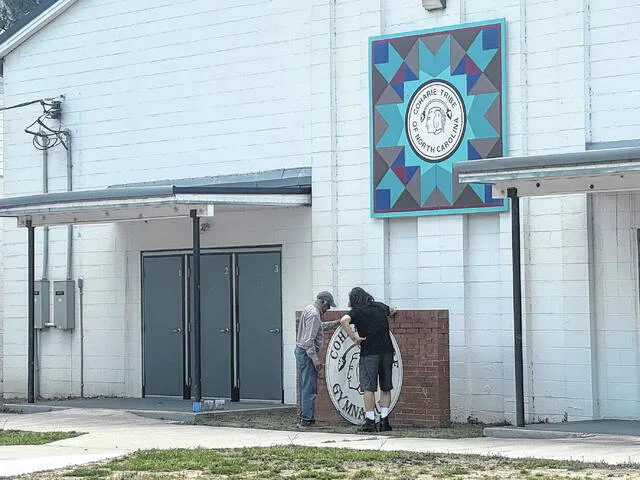
The Coharie Tribal Center is set and ready for a brand new sculpture to be placed in front of its building this coming Monday, June 22. The sculptor and his team will arrive at the center around 11 or 12 that morning.
The sculpture should be up within a couple of hours once they get started, Keith Carter explained during a recent interview.
Carter has helped take the lead in overseeing the project as art director. He worked along with Wendy Bryant, who dealt with business aspects.
They first thought of having a grand unveiling for the sculpture, but due to Vacation Bible School and other classes happening currently in their community, they chose a quieter unveiling, with some media coverage and a few guests.
The center used to be the native school “for all the natives here in North Carolina, so not just here locally,” Carter explained.
“There were like eight different tribes here in North Carolina; this was the only school at the time before they got migrated with the other schools, so everyone all over the state had to drive here.”
The building was dedicated as a school in 1943.
“It thrived until 1965, before integration,” said Mary Brewington Raines, a surviving Coharie teacher who taught at the school.
She graduated from the school in 1955, went to Pembroke State where she got her degree in English, and came back to teach at the school in 1959.
After the school closed in 1965, Sampson Community College occupied the building until 1976, when the county gave the school back to the Coharie people.
Raines left the school in 1964, worked for Sampson Community College for 16 years, retired, and returned to the center in 1982 after her husband died. All the business concerning the tribe is done at the center, Carter explained.
They have a community meeting at the center every month, and, once a year, they have their local Pow Wow where they celebrate their heritage.
“The tribe gets funding for all kinds of initiatives, from cleaning up the Coharie River to providing housing and repairing things some of the folks don’t have the resources for…it doesn’t look like it,” Carter pointed out, “but a lot of money goes through here to fund these projects…millions of dollars.
“Because of them being good stewards of the money, all of a sudden there came these grants to do public art installations, and this is when I come in.”
Carter lived in Washington D.C. for about 25 years, working at USA Today and CNN, doing a lot of animation and graphic work for big media before he retired.
His mother passed away, leaving him with a house, so he and his wife moved back to Sampson.
Carter’s uncle, Greg Jacobs, has been the tribal administrator at the center for over 2o years.
“It’s wonderful, very exciting, the visibility that it’s going to bring to our center and our people,” Jacobs said about the sculpture.
“The symbolism of what this means and the visibility of Native American people here in Sampson Co. is going to increase a great deal.
“I was born in 1953, in segregation, and there was not any visibility for Native American people,” Jacobs explained, “but over the years as we’ve worked hard, we’ve become a valuable part of Sampson Co.
“For people to know that we’re here is so much better than for you to feel like you’re invisible and not have a seat at the table.”
Jacobs called Carter and told him the center had an opportunity to do some art installations.
Carter reflected back on what occurred afterwards.
“I said, ‘OK, I’ll come. At least sit in on the meetings and help initiate some ideas.’ “So I came and initiated some ideas, and of course, everyone was volunteering their thoughts and stuff, and so when I was all done, I was like ‘OK, well goodbye, all the best,’ and I moved on.
“I’m not the only artist in our community,” Carter emphasized, “but I’m the only artist that they know that had certain experience doing work, so they said ‘Can you at least come back and just … we need someone to draw these things for us so we can go ahead and submit…maybe we’ll get this funding, maybe we won’t.’”
He said yes, and did it for free to help the tribe out, although they ended up giving him some money as a way of saying thank you.
“I worked in television, and we used to use all of this 3-D modeling software to create things in the news or in whatever,” Carter said. “So I made models of all their ideas, and now we had this very rudimentary, basic thing, but if you wanted to, you could take the camera through it and stuff.”
A few months later, Carter’s uncle called him up, saying they had over $200,000 now, and needed Carter’s help to make it all happen.
Carter said he would figure it out.
The project was approved for two murals and a sculpture.
Both of the murals were completed by Taylor White, a professional muralist.
The sculptor Carter found is a resident of the Triangle area, Paris Alexander, and has done work for movies and television. Alexander’s work has been displayed in galleries, museums, and universities in countries around the world. His commissions vary from public to private.
The sculpture will be an eagle’s feather made up of limestone, granite, and marble.
Carter just got a chance to see the finished product.
“Everything that I saw three years ago that excited me about his work, I was looking at it now and I was equally as excited, because he did everything that I imagined he could do with his skill set, and boom, there it was.
“This thing is like…over 8 feet tall and like 2,000 pounds, so it’s pretty huge,” Carter emphasized.
“Of course, we did all the prep work with the engineers and stuff to get the ground set to put the piece in, and then we got Perry Jackson, the local electrician, who installed the lights for the murals, and now the lights in the sculpture.
Joe Jones, a local housing director, has also double-checked to make sure everything is good to go.
“The way we have it set up,” Carter explained, “we have a light in the back and a light in the front, and because he (Alexander) has a piece of the sculpture hollowed out, we’re hoping it’s going to look like it’s lit up in the middle at night.”
Carter revealed that they were originally supposed to be finished with this project by December 2025. Alexander was given a six-month extension.
“Because Paris has worked with heavy stones all his life, he had an injury to his back, not necessarily from working with our thing, but years and years of pounding on his back.
“I think he’s going to have to have surgery, but his fear was if he had this surgery, he could be out another six months to two years. So he went ahead and finished this thing, and now I think what he’s going to attend to is his back.”
Carter showed a sculpture of a feather Alexander previously created.
“I could see his attention to his detail,” Carter exclaimed. “This feather, that thing’s made out of stone, but look how soft it looks.”
After first looking at Alexander’s work, Carter had thought, “If I get what I have seen here, then we’re gonna have something … and, of course, he’s knocked it out of the park.”
Originally, the sculpture was going to be placed in front of the mural that stretches all the way across one side of the Coharie Tribal Center, but Carter didn’t want the sculpture to get lost in the mural.
The sculpture will stand on its own in front of the tribal center.
Alexander has also created a 3-D logo for the Coharie tribe that will be placed in front of the tribal center.
“I have not seen the feather,” Jacobs confessed, “but I’ve got this vision in my mind of that light showing through…that’s almost like a people emerging out of the darkness and into the light…people that are very deserving, people that live in a Christ-like manner, and people that are full of light!
“We want to share it with the world; we want to share it with everybody in Sampson Co., and this gives us an opportunity symbolically to do that.”