

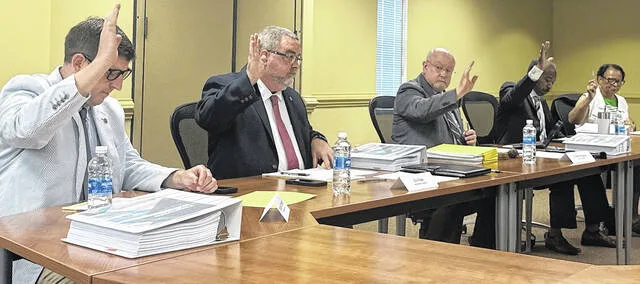
After weeks of workshops, revisions and discussion, the Sampson County Board of Commissioners unanimously approved the 2026-27 fiscal year budget Monday evening, adopting a spending plan county leaders believe positions Sampson for future growth while maintaining financial stability.
The approved budget comes without a property tax increase and includes a 3 percent cost-of-living adjustment for county employees, additional holiday leave, continued investment in economic development initiatives and efforts to streamline county operations through consolidation of positions and services.
For County Manager Allen Vann, who oversaw his first budget process since being appointed to the role full-time, the adopted budget represents months of navigating competing priorities and overcoming early financial concerns.
“There were a lot of competing priorities,” Vann explained. “Initially, we were faced with some truly major financial impacts, and things were looking pretty bleak.”
According to Vann, county staff worked through several significant uncertainties that initially threatened the county’s ability to address employee compensation and other priorities.
“We were able to roll up our sleeves, get the work done and work through some of these situations,” Vann remarked. “The outcome wasn’t quite as dire as it seemed initially.”
One of the administration’s primary goals was addressing employee recruitment and retention after county workers went without a cost-of-living adjustment during the previous budget cycle.
“We wanted to do as much as we could this year to help our staff,” Vann noted. “Our employees deserve it. We have a lot of hard-working employees, and we need to take care of them.”
Vann added that negotiations surrounding health insurance costs and other operational expenses helped the county avoid financial pitfalls that could have diminished the impact of employee raises.
“We were able to leave their insurance just as it is,” he said. “That makes the COLA more meaningful because employees actually see that benefit.”
Commission Chairman Allen McLamb characterized the budget as a success, pointing to the board’s collaboration and confidence in the county’s direction.
“I think we’ve addressed some situations that needed to be addressed,” McLamb reflected. “Not everything was perfect. I know not everybody’s happy, and budgets are not going to make everybody happy. But I think we’re moving the county in the right direction.”
McLamb credited the working relationship between commissioners and Vann throughout the budget process.
“We’re moving 100 percent in the right direction,” he remarked. “By having someone in place, we can get things moving in the right direction earlier than we did this year.”
Looking ahead, McLamb expressed optimism that decisions being made today will have visible impacts much sooner than many might expect.
“Even with economic development and the way things are going with that, I don’t think we’re going to look the same in two years,” he predicted.
Vice Chairman Eric Pope pointed to economic development as the defining feature separating this year’s budget from previous spending plans.
“I think one of the biggest differences between last year’s budget and this year’s budget is we put an emphasis on trying to come up with a plan for economic development moving forward,” Pope explained.
The county has committed resources toward industrial development sites in both Clinton and Newton Grove, projects officials hope will generate future revenue and reduce pressure on residential taxpayers.
“We put a firm commitment into trying to do that,” Pope noted. “We’re trying to reduce the tax burden to the individual residential property owner and include business revenue that can help offset that burden.”
At the same time, Pope stressed that growth efforts must complement, not replace, Sampson County’s agricultural foundation.
“We’ve got to maintain our agriculture base and the industry that’s kept us here,” he added.
Vann echoed those sentiments, emphasizing that economic development remains one of the county’s most important long-term investments.
“We know that we’ve got to increase the non-residential tax base,” Vann observed. “That’s one of the ways we can relieve some of the tax burden from citizens and move the county forward.”
While acknowledging that the county’s economic development allocation is modest compared to larger communities, Vann believes it marks an important first step.
“Five million dollars is a lot of money, but in economic development it’s really not a lot of money,” he said. “At least we’re taking baby steps because we know how critical it is.”
District 3 Commissioner Houston “Chip” Crumpler III focused on the budget’s long-term sustainability.
According to Crumpler, commissioners reduced the overall size of the budget from more than $85 million to less than $85 million while also decreasing the amount of appropriated fund balance needed to balance the spending plan.
“I feel like we’re on a more sustainable path,” Crumpler observed.
He cautioned that future boards must carefully align spending growth with revenue growth.
“As long as those two variables are in line with each other, the budget will always be sustainable,” he attested. “Once recurring expenditures significantly exceed recurring revenues, then you have a crisis where you have to use more fund balance to balance the budget.”
Like several commissioners, Crumpler underscored the importance of continuity within county administration.
“Continuity is very important,” he asserted. “Continuity is a good thing.”
District 4 Commissioner Lethia Lee contrasted this year’s process with the challenges commissioners faced while crafting last year’s budget.
“It was a lot easier than it was last year because we had a real shortfall of money last year,” Lee recalled. “When you’ve got to cut things that you need, it’s not really a good way to budget.”
Lee acknowledged uncertainty remains regarding potential federal and state funding changes that could affect social service programs in future years, but she believes the county is currently moving in the right direction.
“We managed to leave most of the things intact,” she shared. “I don’t know of anything that got thrown out that we needed.”
While she expressed hope the employee compensation package will aid retention, Lee suggested workplace culture and community ties often influence employment decisions as much as salary.
“It’s not all about money,” she commented. “Time is valuable, especially when you have family that you want to spend some time with.”
Lee specifically highlighted the added holiday leave included in the budget as a meaningful benefit for county employees.
“I think those extra days are a good package deal,” she said.
District 5 Commissioner Thaddeus Godwin credited cooperation among board members as one of the most encouraging aspects of the process.
“We, as commissioners, have been working together, and that’s one of the most positive things on this budget,” Godwin shared.
He pointed to employee raises and retention efforts, particularly within departments such as the Department of Social Services, as important investments.
“We’re trying to make sure that the people that are there stay on their jobs instead of going to other places,” Godwin explained. “That makes a difference.”
Godwin also praised Vann’s leadership during his first full budget cycle as county manager.
“Our county manager, in his first year, has done a wonderful job,” Godwin remarked. “Not perfect, but a wonderful job in helping us with this budget.”
The commissioner added that staffing additions within county administration should help improve efficiency and responsiveness moving forward.
“One of the helpful things is our county manager now has more eyes out there to help lessen his load,” Godwin noted. “With the assistant county manager in place, that should help improve things moving forward.”
Vann agreed that continuity will be one of the greatest advantages as county leaders begin preparing for future budget cycles.
“There’s no denying the continuity of remaining as manager and building on prior experiences,” Vann reflected. “Each year helps me better understand the needs and inner workings of the county and how we can continue moving the organization forward.”
As commissioners concluded their budget deliberations, a common theme emerged across the board: while challenges remain, county leaders believe the FY 2026-27 budget provides a foundation for future growth.
“This budget is a step in the right direction,” Lee maintained.
Pope echoed that sentiment.
“You’re always going to have someone say you didn’t do enough here or didn’t cut enough there,” he acknowledged. “But collectively, it’s a good budget.”
For McLamb, the measure of success lies in positioning Sampson County for what comes next.
“I feel like we’ve had a very successful budgeting time period,” McLamb concluded. “And it’s just going to get better as we move.”
Then, with the same optimism he carried throughout the budget process, McLamb looked toward the county’s future.
“We’re going to put Sampson County on the map,” he declared.