
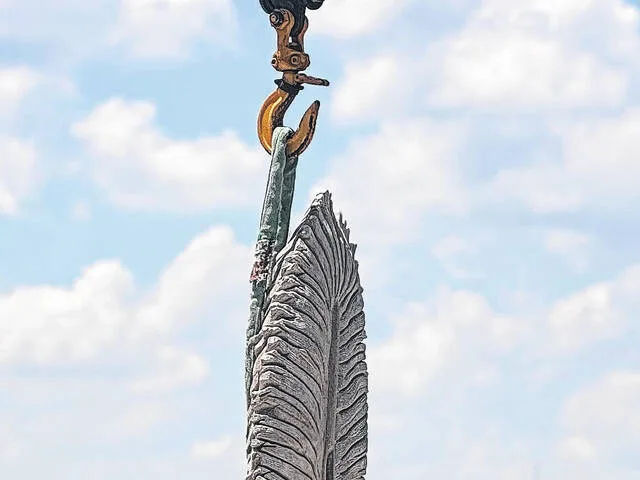
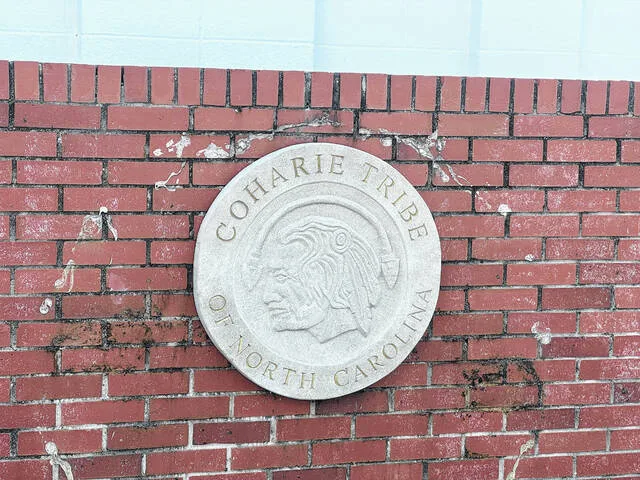
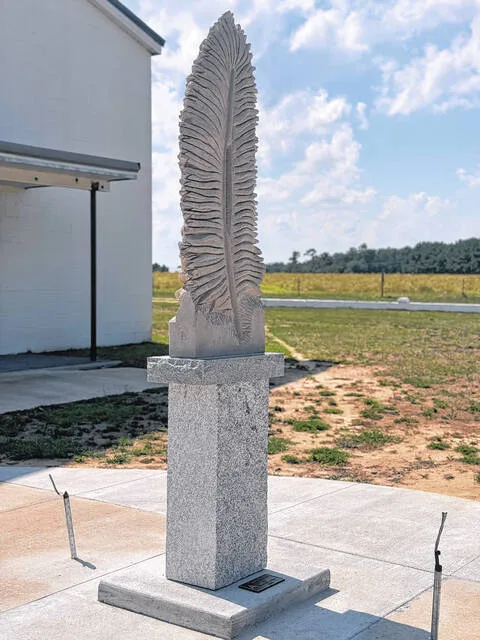
The Coharie Tribal Center received its new eagle feather sculpture and logo Monday, a day that brought pride and celebration to tribal members who gathered to watch the artwork lifted into place.
A dedication ceremony for the sculpture is planned for later this month, though a date has not yet been announced.
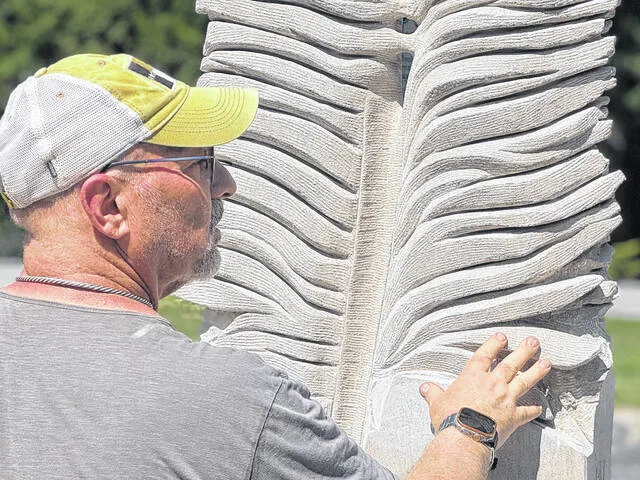
Both the sculpture and logo were created by sculptor Paris Alexander, who arrived with a crew — including his son, Noah — to install the pieces. The team worked through sweltering temperatures throughout the day.
“It was so hot, all of this stuff which is supposed to take 24 hours to set was setting in minutes,” Alexander said while taking a brief break from the work.
Before becoming a full-time sculptor, Alexander spent 10 years at Duke Hospital as a senior research specialist.
“I was in a lot of microsurgeries and stuff like that — I was good with my hands,” he said. “They sent me around for a lot of specialized surgical techniques and things like that.”
Alexander’s interest in sculpting began at an early age while working with clay and wax.
“I probably did my first stone carving when I was about 13, but in terms of trying to make it my vocation, it was April of ’93.”
Since then, he has devoted himself to the craft.
“Everything I’ve done has really meant something to me,” he said.
Alexander left Duke in 1993 and traveled across the country pursuing his passion. His work has since appeared in locations including WakeMed hospitals and Raleigh Little Theatre.
He described the Coharie project as a labor of love and said community participation played a major role in creating the new logo.
“I put all of these marks with red crayon where I wanted everybody to hit with the chisel,” Alexander said. “Then kids, elders and everybody else hit the marks and helped make it.”
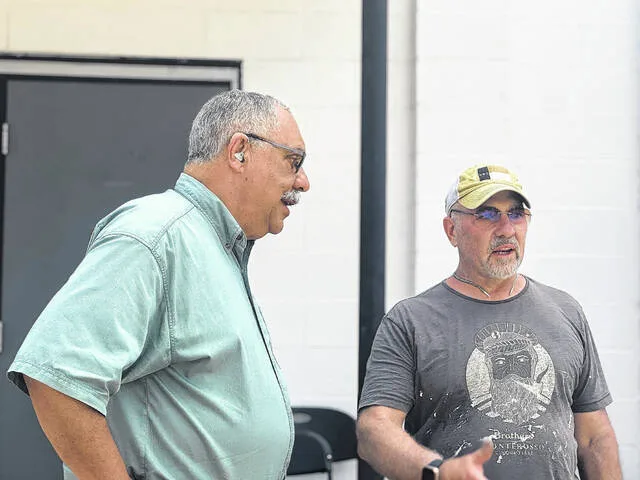
Approximately 75 people attended Monday’s installation, including tribal elders, board members and Chief Ammie Gordon “Silver Eagle” Jacobs.
For Coharie Tribal Administrator Greg Jacobs, the day represented far more than the installation of a sculpture.
“Today was like freedom,” Jacobs said.
“Today was a day that we got to express ourselves as we see fit. It wasn’t somebody else telling our story. We created the story, we constructed the statue and we put our sacred wishes in it.”
Jacobs explained the significance of the eagle within Coharie culture and spirituality.
“We’ve always been in pursuit of God,” Jacobs said. “With the eagle as he flew high into the heavens, before we knew of Jesus, we knew there was a God up there, and we tried to get to Him in every way we could. We would pray that the eagle would carry our prayers up to God.”
Looking across the gathering Monday, Jacobs saw more than a sculpture. He saw a community coming together.
“Today, our community came out. They were happy. They had peace in one accord,” he said. “We had beauty placed on this campus, and they deserve a beautiful campus.”
He reflected on his own childhood memories at the tribal center.
“I could tell you a few things about me going to school out here,” Jacobs said. “I remember that we never got anything new. We never had anything new. When I looked at the sculpture when they brought it, I said, ‘That’s brand new.’
“It’s a new day. We’re thankful to God, and we’re grateful to God. I think He sent favor on us as a people because we strive so hard to serve the Lord.”
Jacobs said today’s generation continues to benefit from the sacrifices of those who came before them.
“If they couldn’t carry a whole load, they carried half a load, and they built a platform where we could at least stand on the stage,” he said. “A platform where we could work hard and have a seat at the table.”
He pointed to his own family as an example.
“My dad and my grandfather worked for these Native American programs and for the rights of minority peoples,” Jacobs said. “I’m getting to live their legacy, and for that I’m very proud. I’m also very proud that the newspaper has come out to help make us visible.”
Jacobs noted that public awareness of Native American communities in eastern North Carolina has not always existed.
“I’ve seen the day when there wouldn’t have been anything written about Native American people for the public to see,” he said. “Pretty much, there was an attitude as if Native Americans didn’t exist east of the Mississippi. But we’re still here and working hard at being visible so people know that we’re here.”
As the sculpture stood in place Monday afternoon, Jacobs said he hopes it serves as a reminder of both the tribe’s history and its future.
“We’re waiting to be that positive part of society,” he said. “We’re waiting to be that example for the next generation that’s going to bring us peace and do away with all of this strife that’s in the world now.”