
The Archibald Monk House, one of the most historic buildings in Newton Grove, has begun to show its age. Now, descendants of the Monk family are asking the town to step in and help preserve the landmark.
This month, the town agreed to take those steps.
The Monk House, originally built in 1824, was moved to Newton Grove in 1976 and now stands near Weeks Park. Over the years, the home was passed down through multiple generations of the Monk family.
As time passed, many members of the family either died or moved away from the area, making it increasingly difficult to maintain the 202-year-old structure. In recent years, town officials have explored the possibility of accepting ownership of the property.
In 2021, former Mayor Stephen Jackson and members of the town board attempted to transfer ownership of the home to the town. However, it remains unclear why that effort did not move forward.
During the town board’s meeting earlier this month, Mayor Craig Warren and board members received a letter from the home’s living heirs asking the town to reconsider taking ownership of the property.
“We’ve done a lot of discussion with different people,” Warren said. “I’ve talked with people at the state level, and, generally, houses and properties with this kind of historical value can qualify for grant funding. If the board agrees to take this property, and the family has offered it to us, they are willing to help contribute. They want to see that property maintained. They don’t want to see it fall into disrepair.”
Warren explained that the property is connected to the town’s park system and stretches to U.S. Highway 701 near the walking track at Weeks Park.
“This has a lot of potential, but it has a lot of expense to get it right,” Warren said. “We can do it as a town. We can come together and make it work. I feel like we can. I hear a lot of positive talk around it. Dana (deputy clerk Dana Ellington) is going to fight to help us secure grant funding if we move forward.”
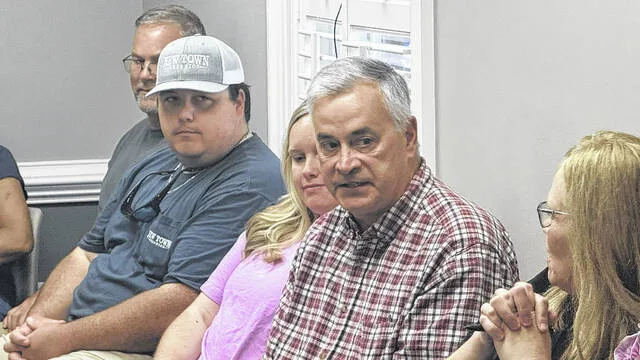
During the meeting, officials learned that the author of the letter was present in the audience. Paul Bell, Monk’s great-great-grandson, attended the meeting as a direct descendant of the family.
“As I said in the letter, we’re trying to figure out a way to get this restored,” Bell told the board. “We came to the conclusion that this was our best opportunity. We are happy to help with grants, contributions and labor if needed.”
The board unanimously approved a motion to pursue ownership of the Monk House property once again.
In a follow-up interview, Bell said preserving the house is important to generations of family members who grew up around the historic structure.
“Our descendants, cousins and children grew up playing in the house,” Bell said. “We’ve always been very proud that the house is still standing after 200 years. I’m thrilled, absolutely thrilled, that we have a potential path forward here.
“I’m happy to work with my cousins to come up with funding and grants to help with that. It also means a lot that people in the Newton Grove area are interested in doing this, because that’s what’s going to keep things going. My family and I are scattered all across the country, but if the local community is really behind us, we can make it work.”
Monk history
Archibald Monk was born Aug. 20, 1788, in Carthage. The oldest of 11 children, Monk moved to Sampson County in 1820 and worked alongside his brother, Cornelius, to open a store in the Piney Grove district. He later established Monk’s Store in the area now known as Monk’s Crossroads.
In addition to his business ventures, Monk operated a plantation that became one of the most productive cotton-producing plantations in the Westbrook district by the outbreak of the Civil War.
In 1829, Monk was elected to the North Carolina General Assembly as a representative of Sampson County. He served in the House of Commons for more than six years as a member of the Democratic Party before later helping establish the Whig Party in Sampson County after leaving the Democrats.
After concluding his service in the House of Commons in 1835, Monk ran unsuccessfully for the state Senate.
Monk also played a significant role in the advancement of education in Sampson County. During his time in the General Assembly, he helped establish some of the county’s earliest academies, including Holly Grove Academy and Clinton Academy. He later served as chairman of the Board of County Superintendents until 1865.
Monk died June 7, 1869, in Monk’s Crossroads.
Town officials are now exploring grant opportunities and other options that could help fund restoration efforts for the historic Monk House.