
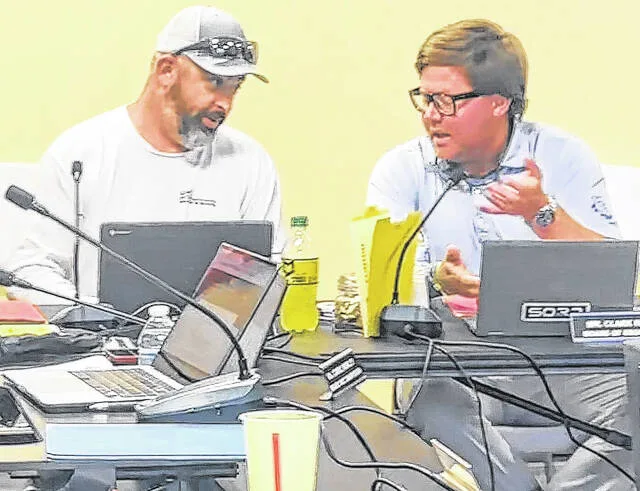
A Clinton City Board of Education member encouraged his colleagues to violate the Constitution and state law Monday, calling for them to consider having chapels at the five schools and noting his belief that doing so would thwart at least one reason parents send their children to private institutions.
“We, as a board, agreed to break the law to start school early and end early, so I wouldn’t be afraid to do it for this,” attested board member Clark Hales, about chapels at the schools and referring to the city board’s earlier decision to go against state Department of Public Instruction policy on when to open schools this year. City schools begin on Aug. 10, earlier than the Department of Public Instruction calendar.
Hales announced his desire for chapel to be included at each of the five schools in the district during a Monday Board of Education meeting, after superintendent Dr. Wesley Johnson reported that North Carolina is going to allow students to have one to four hours per week of excused off-campus absences for religious activity.
“I think a board retreat might be the proper place to talk about this, but I don’t think it’s any secret that we’ve lost children to the private schools … I hear it’s the religious time, chapel,” Hales said as he began to advocate his own idea of placing a chapel at each city school as a replacement for a state mandate to provide the one to four hours per week of excused off-campus absences. Hales commented that his wife is a first grade teacher and would lose too much instructional time trying to keep track of who was checking in and out for any off-campus religious instruction. “Why can’t that time be for chapel?” Hales asked as he emphasized how much class time would be lost with students leaving school for religious instruction and, at the same time, proposed the solution of incorporating chapel at all five district schools.
John Lowe, executive director of Technology & Auxiliary Services for Clinton City Schools, warned that such a move would go against state and federal law, explaining that the system had to be careful with such an idea, noting the Constitution’s First Amendment, which establishes that “Congress shall make no law respecting an establishment of religion, or prohibiting the free exercise thereof,” what Thomas Jefferson referred to as separation between church and state.
“Section 5 states the public school unit shall prohibit any private entity from offering released time religious instruction on school property unless otherwise permitted by a neutral facility use policy,” Lowe pointed out in regards to the laws listed in general statutes.
“Why would we not find a way to have chapel in each of the schools?,” Hales pressed on. “We obviously have a minister on the board. Some of our schools have indirect partnerships with local churches already.” The board member then added “the light bill’s getting paid,” explaining that holding chapel would not cause additional costs for the district.
“If it’s in our building, we are expending local funds for the utilities and site maintenance,” Lowe attested as to why chapel can’t be held on public school property as a mandated part of the school day.
According to N.C Press Association attorney Mike Tadych, both the U.S. and North Carolina constitutions “guaranty religious liberties and the separation of church and state. Some recent caselaw indicates that spontaneous religious activities led by school administrators (like praying on the football field after the game) are OK but cannot be mandated.” explained Tadych.
The U.S. Department of Public Education website states: “As government officials, public school employees must remain neutral towards religion and non belief while acting in their official capacities.”
Students are free to participate in their religious customs at school, according to the N.C. Department of Public Instruction. They may organize religious clubs to the same extent they are permitted to organize nonreligious clubs. And, this new law, yet to be implemented, from the state of North Carolina articulates that students may leave campus to participate in religious instruction, not that religious services can be a mandated part of the school day.
Hales emphasized that having chapel could be part of what he called “the disrupt” in “One Dark Horse – Dare, Dream, Disrupt,” the 2026-27 district slogan. “This would feed into disrupt. What are we doing different to serve our kids in Clinton?” asked Hales.
“I don’t care what any other district in the state is doing; we live in Clinton and we serve the kids of Clinton,” Hales stressed, addressing those remarks to board chairwoman Dr. Linda Brunson.
No decisions were made, but some board members throughout the discussion urged addressing the issue in a closed session with their lawyer, while other members, including Hales, referred to a private board retreat, both of which would breach the N.C. Open Meetings Law, which states that all official meetings of public bodies, including elected boards, where policies are being deliberated, shall be open to the public.
Attorney Tadych stated the board ”cannot discuss policy for mandating chapel [during closed session]. Doing otherwise would violate the Open Meetings Law.”
However the Press Association attorney did note that the school board could meet with its attorney to discuss its “exposure” for mandating chapel or placing chapels on school property but not for discussing the policy to do those things.
Toward the end of the discussion, Hales, once again reiterating a possible discussion in a private retreat, concluded that the board pays its attorney and her firm and “they can fight the fight for us if someone says we’re doing something wrong.”
There is no such thing as a “private retreat” for school board members or any other public board. All boards are required by law to have meetings open to the public each time a quorum of a board is together, only closing the door to the public for specified legal reasons such as personnel matters and student issues.
NCDPI states that one of the pillars to achieve academic excellence is ensuring a healthy school environment, one that prioritizes inclusion and belonging. Mandating chapel, based on one of those tenets, as part of school chooses one religion, but leaves out the rest, which directly violates the First Amendment.