
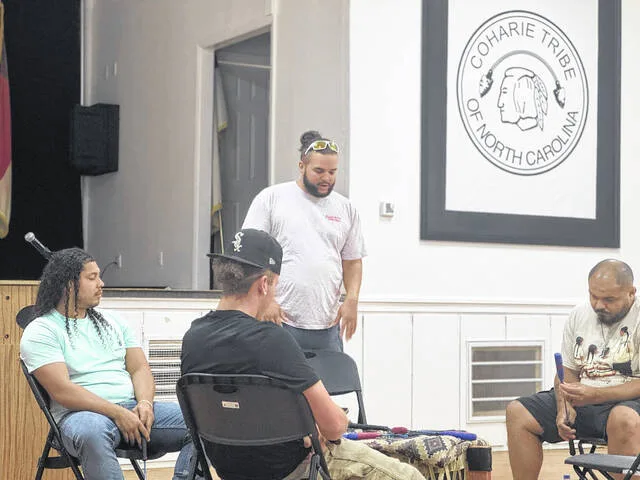
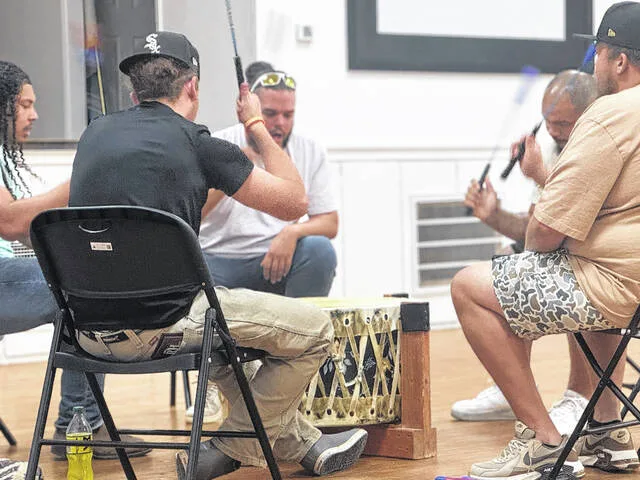
The sounds of drumming and singing filled the Coharie Culture Center auditorium as women and children danced to the music in a powwow etiquette class this past Thursday evening.
The 56th Annual Coharie Indian Cultural Powwow will take place Sept. 11-12, at the Coharie Tribal Ground. There will be American Indian drumming and dancing competitions, American Indian foods, crafts, artwork, gospel singing, and the Warrior’s Ride, a way to honor veterans and military service personnel.
Powwows were originally a war dance; a lot of the old songs would have to do with wars, veterans, and combat. There was only one men’s dance, which is known today as the Men’s Southern Strait dance, and there was only one women’s dance, known as the Women’s Southern Traditional dance. Originally, those were the only two dances to the big drum.
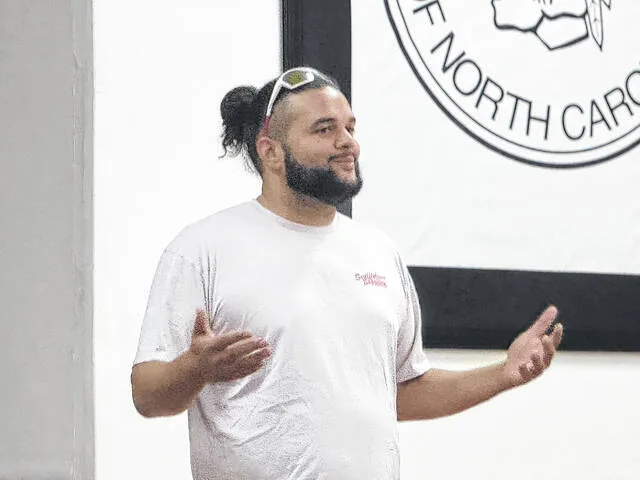
In the powwow class, before the big drum began, Cory Brewington, a local Coharie resident, talked about the etiquette and origin of the powwow.
He explained that most powwows around Indian country are the same. The powwow is a gathering of native people to celebrate with dance and songs. A lot of communities do their own kind of twist on it, so if they have certain songs or dances that they do specifically, they incorporate that into their powwows he said, noting that powwows didn’t come from Eastern tribes.
“A lot of people, especially in the Eastern tribes, have taken upon the powwow culture, which is what we would call Pan-Indian(ism). That would be when you’re utilizing different aspects of different cultures to dance and sing within a powwow. So this big drum style of song, and a lot of these dances that we do in powwows, they’re not from here at all. … they all come from the Plains and Great Lakes regions.”
Most of the communities in North Carolina did not have their first powwow until the early 1970’s.
“A lot of people didn’t like it, because they wanted to stick to our traditional teachings. If you really think about it, we did lose a lot of that, and it’s kind of sad to think that we had our own traditional songs and music that people were ready to teach. … It’s crazy to see now that people were more willing to be involved in the powwow culture than they were in the traditional culture beforehand.”
Many tribes argue about who started the big drum, but it originated in the late 1700’s and early 1800’s, so a lot of songs heard in powwows are no older than 200 years or so. The style of Southern singing started in the Plains region with the Ponca and the Kiowa tribes.
“The story of the drum, I’ve heard many different versions of it, and I was told, depending on what versions of stories you hear at the time, you’re supposed to hear that certain version for your life,” explained Brewington. “So, there are different kinds of origin stories for the drum, but one thing that they all hold principle to is that a woman made the drum. A woman had the first vision of the big drum, and she gave it to the men in the community.”
The reason for that was that the men in the Plains area had succumbed to alcoholism.
“The men were no longer taking responsibility for their communities, so the woman had a vision about making this drum, and giving the drum to the men in the community so that they would have something to take care of, so that it would start instilling responsibility back into them.”
That’s still carried on today. The men sit at the drum, and the women sit or stand behind the men and sing.
“The reason for that is that since the drum came from a woman, it’s said that the beat we have with it is the heartbeat of Mother Earth. The women already have that, because they have the ability to have children, and men don’t. So, a lot of people say, ‘Isn’t it kind of sexist that women don’t get to sit?’ But really, it’s because this is beneath women. That’s why they stand behind the circle of men.”
There are, he noted, a lot of powwow songs written by women. Nowadays, if people go online, they can find plenty of drum circles that are made up of women, but most of the time, those are certain cases where a community has nothing but girls, or if a known singer had nothing but girl children, he would teach his daughters to carry on the drum.
“The big thing about understanding powwows, as far as what our communities need to learn, is that it is an adopted culture, and the fact that you powwow is not a good enough reason to say, ‘I’m Coharie.’ … It’s not an identity for East Coast Native Americans, because none of this stuff comes from around here.”
A lot of times, powwows are not for the community in the community where they’re being held. The powwow is thrown for the people who come to the community. It’s not really for spectators and visitors; it’s more for the dancers and singers.
“I will stress to all of you that it’s important to learn things, but powwow should not be as important as it is on the East Coast,” Brewington impressed upon the students in class. “We should be way more interested in learning some of our traditional things.”
He explained further that understanding the difference in traditions and the history is an essential part of learning powwow etiquette.
“That being said, when we do go to powwows, there’s a certain etiquette of how you do it. … A lot of that starts with beginning to understand that it did not come from around here, and it’s not ours. A lot of these dances in these songs are not ours to change, and they’re not ours to change the idea of what it’s supposed to be.”
Moving into things like regalia and different categories, there’s a box of principles for each category, and the pieces of those regalia all signify something specific for that category of dance.
“You would never not have one of those pieces, or change one of those pieces to make it something else, because you’ve got to remember that the dances didn’t come from around here, and when we do things like that, it makes us lose…the traditional story that was attached to the dance. All of those pieces have meaning.”
The songs for the evening were provided by Brewington’s drum group, Smokey River Singers. The drum group consists of Brewington, Kris Royal, Braycee Gibbs, Jordan Davis, and Cameron Price. They travel and sing for different communities all around the country, though Brewington added that they try to stay along the East Coast. Smokey River is classified as a Southern drum.
Brewington said they started the group when they were teenagers, and that being able to travel to many different powwows and see a lot of different people has given them perspective on powwows and staying rooted in Indian identity.
“We started when I was like, 13, so man, that was 19 years ago. … We’ve been around for about 20 years. … Over the years, we’ve seen a lot of men come, a lot of families come and go, because like I said, the powwows are always going to be there, but they should not be our Indian identity.”