
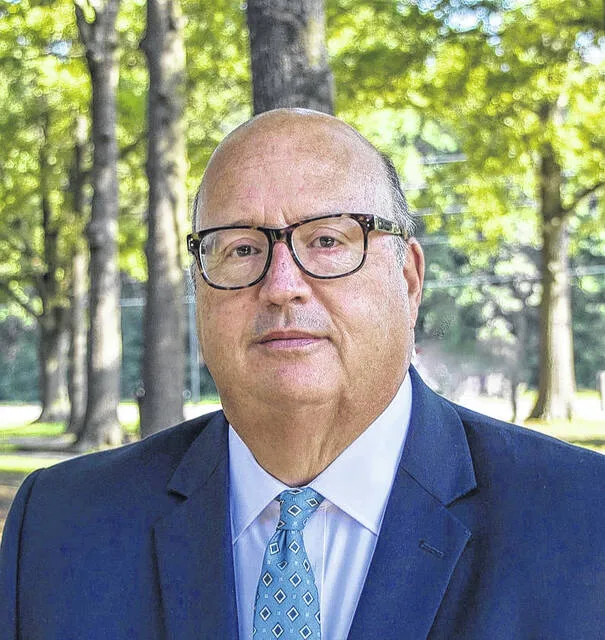
Sampson Community College will be required to certify that it is complying with a new North Carolina law restricting diversity, equity and inclusion initiatives at the state’s public colleges and universities, though SCC President Dr. Bill Starling says the legislation is expected to bring little noticeable change to the local campus. That certification must be completed by Sept. 1
Starling briefed the SCC Board of Trustees on the new requirements during its Tuesday meeting, outlining provisions that prohibit public institutions of higher education from maintaining DEI offices, promoting certain concepts defined by the state as divisive or discriminatory, and using race or sex as the basis for certain institutional practices.
For SCC, Starling explained, compliance should be relatively straightforward because the college did not have a DEI office or programs that would have to be dismantled.
“For us here, there’s really nothing that we have to change, because we were not engaged, to my knowledge, in any activities that had to be halted,” Starling said in an interview following the meeting.
The changes stem from Senate Bill 558, entitled “Eliminating ‘DEI’ in Public Higher Ed.,” which became Session Law 2026-21 after the Republican-controlled General Assembly overrode Gov. Josh Stein’s veto June 24. The legislation applies to North Carolina’s community colleges as well as constituent institutions of the University of North Carolina system.
The state legislation also points to developments at the federal level. In explaining its rationale, the law cites a January 2025 executive order from President Donald Trump directing higher-education recipients of federal funding to comply with federal anti-discrimination laws and the U.S. Supreme Court’s 2023 decision in Students for Fair Admissions v. Harvard, which struck down race-conscious admissions programs at Harvard University and the University of North Carolina. North Carolina lawmakers also cited the state’s receipt of approximately $2.4 billion in federal funding for public higher education during the previous fiscal year.
Under the new state law, the State Board of Community Colleges must adopt a systemwide policy governing diversity, equity and inclusion. The board must also prohibit community colleges from establishing or maintaining processes to report or investigate offensive or unwanted speech when that speech is protected by the First Amendment, including satire or speech characterized as a microaggression.
Starling emphasized that provision to trustees.“You have to read this carefully,” he cautioned.
If comments made in a classroom are considered offensive by some students but remain constitutionally protected speech, Starling explained, the college cannot establish a process to investigate the speech merely because it caused offense.
The legislation further prohibits public colleges from maintaining an office, division or other unit named for diversity, equity and inclusion or one that promotes discriminatory practices or concepts the law defines as “divisive.” Colleges also cannot employ or assign someone whose duties include promoting those practices or concepts.
Among the “divisive concepts” specifically defined in the legislation are assertions that one race or sex is inherently superior to another; that a person is inherently racist, sexist or oppressive solely because of race or sex; that an individual’s moral character is necessarily determined by race or sex; or that an individual bears responsibility for past actions committed by other members of the same race or sex.
The law does not prohibit classroom discussion of those subjects. It specifically protects First Amendment speech and allows instruction or discussion concerning divisive concepts as long as the institution does not endorse them. Certain courses dealing with those subjects may also remain required when necessary for a particular degree program, subject to provisions contained in the law.
Starling told trustees that faculty members will be educated on the requirements as they relate to coursework and classroom instruction.
“We do have an obligation to educate faculty on it each year, and we will be doing that,” he noted.
Another area discussed during Starling’s presentation involved scholarships.
Starling pointed out that institutions must ensure scholarship practices do not exclude students based on characteristics such as race or gender. Colleges that historically maintained scholarships with such restrictions may have to revisit their terms, potentially working with donors or families to amend the language.
SCC, however, does not expect that provision to result in significant changes either, according to to the college president.
“We didn’t have practices which only provided scholarships to women versus all genders,” he explained. “We had worked to provide scholarships to first-generation students, not students of one particular racial group.”
Starling stressed that the college’s approach has been to make educational opportunities available based on factors such as merit and financial need while serving students from across the demographic makeup of Sampson County and beyond.
“Consistent with the mission of the college, we have been trying to be as open and supportive of all groups as we could,” he said.
One of the most direct requirements facing Starling personally will come each September.
The law requires every public institution of higher education to certify in writing by Sept. 1 that it is fully complying with the requirements. Those certifications go to the institution’s governing authority — the State Board of Community Colleges in the case of community colleges — and must include actions taken to achieve compliance. The governing boards will then compile the certifications into reports for state lawmakers.
For the initial implementation, institutions are also required to provide information concerning any reductions in workforce or spending, changes to job titles and position descriptions and the use of savings resulting from compliance. A subsequent legislative technical correction specifies the initial certification deadline as Sept. 1, 2026.
Starling described the annual presidential certification requirement as an unusual aspect of the legislation, but noted that he does not anticipate difficulty certifying SCC’s compliance.
“It’s going to be easy for us to do,” he reiterated.
Although DEI has become a politically charged issue nationally and in North Carolina, Starling cautioned against assuming the legislation means SCC will change how it serves its students.
“Please don’t be drawn into a lot of the divisive political speech surrounding the use of these words,” Starling urged.
He characterized the practical effect at SCC as ensuring students and employees continue to be treated equally within a state-funded institution.
“I think the purpose of the legislation, in general, was to just make sure that everybody is treated equally with the use of state funds and in state institutions,” Starling explained. “It is politicized, and that’s the environment we all live and work in, but I think it doesn’t threaten any of us.”
For students arriving on the SCC campus this fall, the college president maintained that the result should largely be business as usual.
“I don’t think you’re going to see anything any different here as a result of the law,” he concluded.