
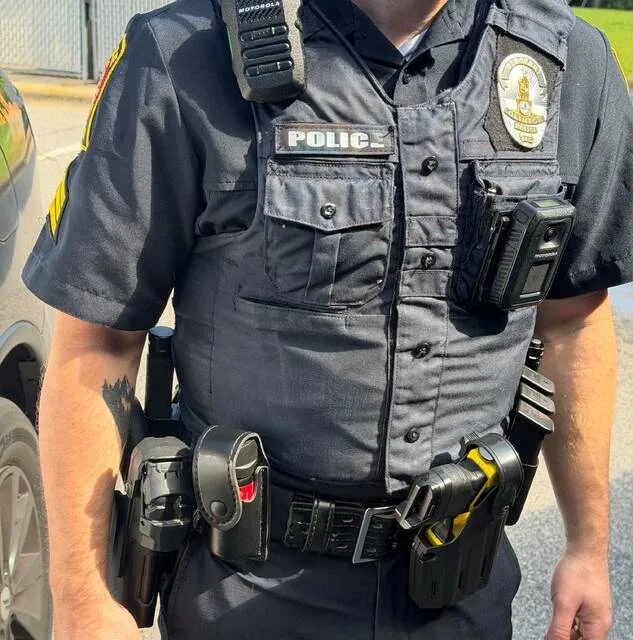
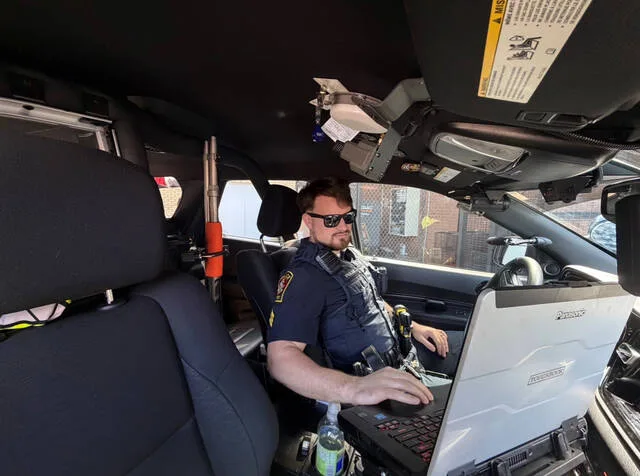
All sworn officers with the Clinton Police Department carry less-lethal equipment as part of their normal duty equipment, and as a means of providing alternatives to handling use-of-force situations that arise in the field, according to department officials.
Clinton Assistant Police Chief Jesse Kittrell recently discussed the equipment, training requirements and the department’s emphasis on de-escalation when circumstances allow.
“These tools are intended to provide officers with additional options for safely gaining control of resistant or potentially dangerous individuals while, when reasonably possible, reducing the likelihood that a higher level of force will be necessary,” Kittrell explained.
Less-lethal options used by Clinton police include ASP expandable batons, Taser 10 conducted energy weapons, oleoresin capsicum (OC) spray and shotguns equipped with drag-stabilized bean bag rounds.
For specialized equipment, such as the less-lethal shotgun and Taser 10, officers must receive appropriate training before being authorized to carry or deploy it. Kittrell said officers also undergo refresher and proficiency training covering safe handling, deployment procedures and other considerations associated with using the equipment.
“Officers authorized to carry or deploy these less-lethal weapons receive training on their proper use, applicable departmental policies, safety considerations, deployment limitations and appropriate decision-making,” Kittrell added.
Officers are also required to complete annual training or recertification when applicable to the particular weapon and departmental mandates.
Annual training generally includes a review of the department’s use-of-force policy, legal considerations, de-escalation principles, weapon-specific procedures, practical skills and scenario-based decision-making.
“Training is intended not only to ensure that officers remain proficient with the equipment, but also that they understand when the use of a particular less-lethal option is reasonable and appropriate under the circumstances,” Kittrell stressed.
Officers are trained to evaluate situations individually and determine what level of force is objectively reasonable based on the circumstances.
Kittrell described less-lethal equipment as one component of the department’s broader approach to use of force and de-escalation.
“De-escalation is not limited to a single technique or piece of equipment,” he explained. “It is part of how officers approach situations on a daily basis. An officer’s professional presence can, itself, help stabilize a situation before any physical intervention becomes necessary.”
Officers are also trained to use communication, verbal direction, active listening, time, distance, positioning and other techniques when circumstances allow in an effort to reduce tension and gain voluntary compliance.
Each year, Clinton police officers participate in mandatory in-service training that includes use-of-force principles, legal updates, decision-making, de-escalation techniques and practical application.
Other training includes officer safety and tactical decision-making, communication skills, recognizing individuals who may be experiencing a crisis, control and restraint techniques, less-lethal equipment and firearms. Kittrell said officers are also trained on their responsibility to provide or request medical assistance following a use-of-force incident, when appropriate.
The department’s program also includes documentation and supervisory review. Uses of force are documented and reviewed for consistency with department policy, training and applicable law, according to Kittrell. Those reviews can also be used to identify additional training needs, equipment considerations or areas where practices could be changed.
“Ultimately, our training emphasizes that the goal is not simply to teach officers how to use force, but to teach them how to recognize when force is necessary, what level of force is reasonable under the circumstances, and when other options may allow a situation to be resolved safely without resorting to additional force,” Kittrell said.