
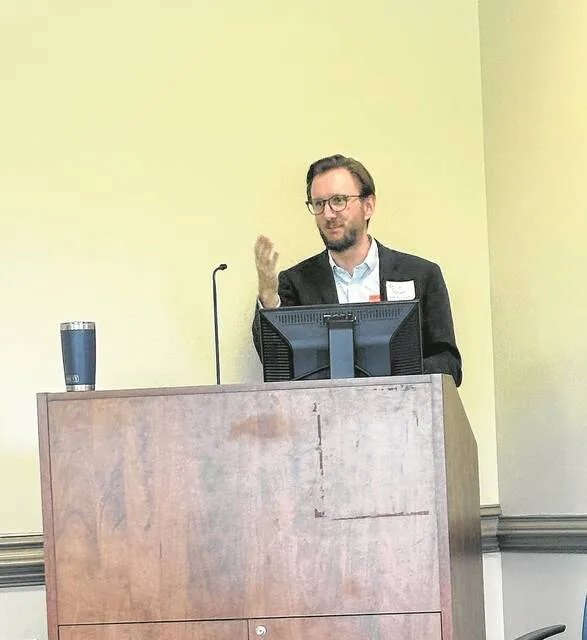
Public health officials and local government representatives from Sampson and neighboring counties gathered at the Sampson County Health Department Wednesday to discuss strategies to improve public health at the local level, as well as ways to give state legislators a better picture of what is happening in local health departments.
North Carolina Public Health Collaboration Executive Director Patrick Brown started the strategy session with a picture of public health in North Carolina, explaining that the state has a “decentralized public health” system, with 86 health departments serving as the only “safety provider in all 100 counties.”
“There’s access to public health everywhere, and that’s something we take pride in,” Brown said.
“More than anything, I hope you leave here thinking about moms and babies,” Brown stressed, explaining that a significant part of public health involves caring for mothers and children and ensuring quality care is available for them across North Carolina.
Brown gave an example of the importance of local public health efforts beyond what many may associate primarily with restaurant sanitation scores. Last year in North Carolina, he said, a certain applesauce was determined to contain lead because the cinnamon used in the product had been contaminated with lead.
Local public health representatives went to grocery stores and ensured the applesauce was removed from shelves in a matter of days, Brown said.
State Sen. Jim Burgin, who represents District 12, was in attendance, and lobbyist Ashley Perkinson facilitated a question-and-answer session to give local public health and government representatives an opportunity to discuss how legislation affects public health.
Burgin urged attendees to invite their representatives to visit their health departments.
“And don’t invite them when nobody is there,” he stressed, emphasizing the importance of legislators seeing local health departments in action so their work in the Senate and House reflects needs at the local level.
“If someone is coughing, they need to hear them cough,” Burgin emphasized, before joking, “but not to spread anything.”
The senator added that if it were up to him, he would also make sure there were plenty of babies and young children around during a legislator’s visit.
“When we walked in, did you see that mom waiting with her cute baby?” he asked the crowd. “I wanted to stop and talk to her. The way you capture a senator is to bring a cute baby.”
Burgin said health care has long been a focus and passion for him after years in the health insurance business, sharing that “North Carolina has some of the most expensive healthcare in the country and,therefore, the world,” while discussing his legislative work aimed at lowering costs.
He also said “mental health remains one of his passions” and discussed what he sees as the need to change the state’s approach to health care.
“We’re mostly reactive,” Burgin said, “but we need to be responsive, not reactive.”
“What happens when you react to a med?” he asked the group of public health officials.
“It’s not good,” those in attendance agreed.
“What about if you respond to a medication?” Burgin asked.
“That’s what we want,” was the consensus.
After the question-and-answer session, those in attendance broke into small groups to discuss the question, “What public health responsibility is difficult to provide under current restraints?”
In one group, Sampson County Commissioner Lethia Lee said the “biggest problem in Sampson County is retaining employees.” Lee highlighted what she described as a growing number of open positions and increasing difficulty retaining workers.
Lee said more workers are leaving Sampson County for nearby counties where the pay is better.
“We’re a poor county. We don’t have more funds available to raise the pay,” she stressed.
Duplin County Health and Human Services Deputy Director Lance Davis responded to Lee, saying, “We in Duplin County have the same problem.”
“They come to us from you (in Sampson), but then they go to Pender and then to New Hanover because they each offer more money,” Davis said.
Davis added that rural counties often have more responsibilities divided among fewer positions, leaving resources stretched thin.
The Duplin deputy director also pointed to what he described as a “generational shift,” saying remaining in the same position for the long haul is not as much of a priority as it once was.
When the groups presented their ideas, participants raised the question of why A1C and cholesterol testing are not available at local health departments. Burgin agreed “that’s important and would get people in the door,” adding that he intended to work on making it possible.
“I know how to write a bill,” he stressed.
Sampson County Manager Allen Vann presented for his group, pointing to the financial pressures counties face.
“You continue to have unpaid mandates while at the same time property tax reform, which is our biggest revenue source. You cannot have it both ways,” Vann stressed.
He also echoed concerns raised about the workforce, pointing to what he called a “societal shift in work ethic” and saying employees are being given more work without competitive pay.
Similar strategy sessions are being held across North Carolina, providing regionally focused discussions and allowing neighboring counties to work together on issues affecting the health of their communities.