
See Guest Oped A6
Sampson County commissioners made a unified appeal Monday night for voters to support the proposed half-cent sales tax on the Nov. 3 ballot, with one commissioner going a step further by suggesting approval could open the door for property tax relief next year.
District 3 Commissioner Houston “Chip” Crumpler III said that if voters approve the additional 0.5% sales and use tax, he intends to advocate during the next budget process for reducing the county’s property tax rate by approximately 1 cent.
“As we look ahead to next year’s budget, if the sales tax is approved by the voters, I believe we should continue looking for opportunities to provide property tax relief while still meeting the obligations and service needs of Sampson County,” Crumpler stated.
He stressed that he was not promising a tax reduction on behalf of the full board and acknowledged that commissioners cannot bind a future board to a particular tax rate. Any reduction would have to come through the normal budget process, he noted, and depend on actual revenues, expenditures and the county’s overall financial condition at the time.
Still, he maintained that the possibility deserves consideration if the referendum passes.
“If this additional sales tax revenue becomes available to the county, I intend to advocate that this board consider reducing the property tax rate by approximately 1 cent next year,” Crumpler attested.
The referendum was made possible through state legislation granting Sampson County authority to levy up to an additional 0.5% local sales and use tax. The legislation requires voter approval through a referendum followed by action from county commissioners before the additional tax can be levied.
Proceeds from the new sales tax, if approved, would be restricted for public-school capital outlay and operating expenses. The new authority is separate from the optional quarter-cent sales tax already levied by Sampson County.
Crumpler noted that his support for considering property tax relief stems from a belief that additional revenue should not automatically translate into additional county spending.
“If our revenues allow us to reduce the burden on property taxpayers while continuing to meet our responsibilities to education, public safety and other essential county services, I believe we should seriously consider doing so,” he remarked.
At the same time, Crumpler emphasized that county government must continue looking for efficiencies regardless of whether additional revenue becomes available.
“Additional revenue should not relieve us of our responsibility to continue to control spending, operate efficiently and be good stewards of taxpayers’ money,” he stressed.
Crumpler summed up his position by noting that if voters agree to pay an additional half-cent sales tax, he hopes commissioners can provide some relief on the other side of the tax ledger.
“If the sales tax referendum is approved, next year I, as a commissioner, can advocate that we reduce the property tax rate,” he continued. “If the sales tax is increased by half a cent, I’m hoping that we can reduce the property tax rate a full cent in order to help make things easier for the taxpayers and public.”
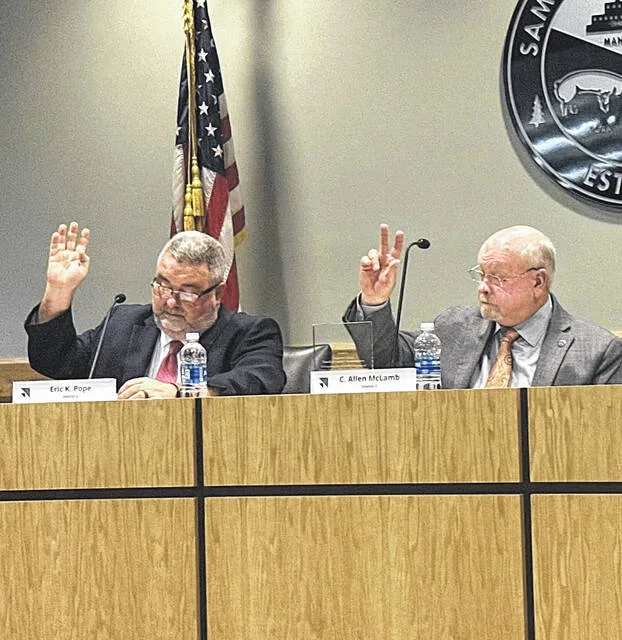
Vice Chairman Eric Pope, District 2, voiced support for Crumpler’s proposal while addressing what he described as a misconception that commissioners themselves were imposing the sales tax.
“We did provide the citizens an opportunity to make a decision,” Pope clarified.
Commissioners previously voted unanimously to place the referendum before voters after the N.C. General Assembly granted Sampson County the additional taxing authority.
Pope explained that the county continues to face increasing demands for services while its available revenue sources remain limited. In his view, the county will eventually have to find additional revenue, increase its reliance on property taxes or reduce services.
“I don’t want another property tax increase,” Pope stressed. “That means we’re actually cutting services. I don’t want to cut services that are essential to this county.”
The vice chairman added that he believes the sales tax could provide another revenue stream while easing some of the pressure traditionally placed on property owners.
“I think the sales tax would be beneficial in helping to increase the revenue so that we could provide some relief for property tax owners who have shouldered most of the burden over these years,” Pope stated.
He then joined Crumpler in expressing willingness to consider lowering the property tax rate if voters approve the referendum and county finances make such a move possible during next year’s budget process.
District 5 Commissioner Thaddeus Godwin also encouraged residents to consider the referendum, describing the election as an opportunity for citizens to have a direct voice in the county’s financial future.
“It gives each one of us a chance to make an impact on how we vote,” Godwin remarked. “We want you to really consider looking at that value and thinking about, ‘OK, this is where we want to help our county.’”
Godwin also used his comments to discuss concerns heard during a recent gathering of county officials about the Supplemental Nutrition Assistance Program, commonly known as SNAP. He pointed to Sampson’s economic challenges and the number of residents who rely on assistance to purchase food.
“We have a county that is not the richest county in the world,” Godwin observed. “Without SNAP, many of our people will be hurt.”
District 4 Commissioner Lethia Lee similarly appealed to voters, pointing to Sampson County’s financial challenges and the continuing demand for county services.
Lee noted that county leaders have sought additional sales tax authority for several years and contended that additional revenue could help Sampson provide services comparable to those available elsewhere in the state.
“You know, a lot of people ask, ‘We want this, we need that. Why don’t we have this?’” Lee said. “Because we don’t have the money.”
She characterized Sampson as a financially challenged county but maintained that should not prevent local leaders from seeking ways to improve services for residents.
“We want y’all to have just as much as they have anywhere else in this state because we care about this county just that much,” Lee emphasized. “So we’re asking that you just please think about it.”
Chairman Allen McLamb, District 1, echoed the discussion of Sampson’s Tier 1 economic designation but emphasized that he views the county’s greatest resource as its residents.
“We are a Tier 1 county, and that’s OK,” McLamb stated, adding that while Sampson may face financial limitations, “this county is rich in people.”
McLamb also discussed his participation in the recent N.C. Association of County Commissioners gathering, where he said SNAP and other issues affecting counties across the state generated considerable discussion.
The chairman reported that he had been invited to serve on the association’s Agriculture and Natural Resources Steering Committee and had also been appointed to its Executive Committee, giving Sampson representation in discussions on issues affecting county governments.
“That gives us a voice that we haven’t had in Sampson County in a while,” McLamb noted, adding that he takes the responsibility of representing the county seriously.
If voters approve the referendum Nov. 3, the additional sales tax would not automatically take effect simply as a result of the vote. State law requires commissioners to subsequently approve the levy, and the legislation allows the additional tax to be implemented in quarter-cent increments up to the half-cent maximum.
Any revenue ultimately collected under the new authority would be restricted to public-school capital and operating expenses rather than becoming unrestricted county revenue.
For commissioners Monday, however, the discussion centered not only on what additional sales tax revenue could provide for education, but also what it could potentially mean for property owners when the board begins crafting its next county budget.
Crumpler stopped short of promising that a 1-cent property tax reduction would occur, repeatedly stressing that the decision would depend on the county’s finances at the time. But he made clear that, should voters approve the sales tax, he intends to put that discussion before his fellow commissioners next budget season.
Commissioners
recognized
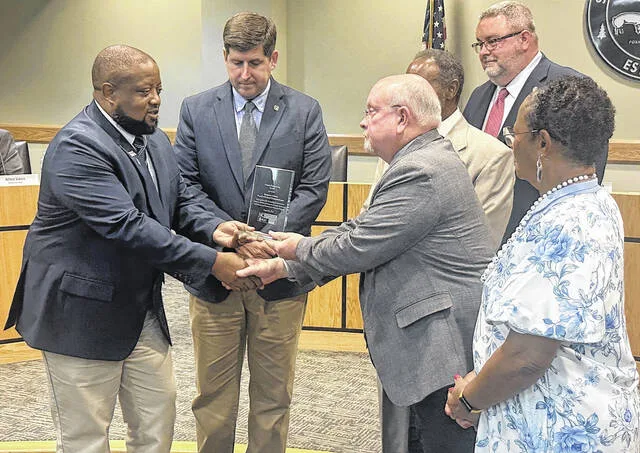
In other business Monday, the Sampson County Board of Commissioners was recognized for its support of N.C. Cooperative Extension, receiving a County Partnership Award that was presented to only seven counties across the state this year.
N.C. Cooperative Extension District Director Dalton Daughtry presented the honor, recognizing the board for what the award described as its “outstanding commitment of resources, inclusion of Extension in county government, and advocacy and involvement in Extension programs.”
Daughtry, who told commissioners he oversees 18 counties, has ties to Sampson County from earlier in his Extension career, having previously worked locally as a county agent.
“It’s good sometimes to go back home,” Daughtry remarked before thanking commissioners for their continued relationship with the organization.
The district director emphasized that Cooperative Extension’s work across North Carolina relies heavily upon partnerships with county governments, which provide local support and resources that allow Extension programs to operate within their communities.
“We couldn’t do what we do if we didn’t have a partnership with counties,” Daughtry explained. “Every single county in the state of North Carolina partners with Extension.”
That relationship is particularly visible in Sampson County, where the local Extension Center provides programming in areas including agriculture and natural resources, 4-H youth development and family and consumer sciences.
Daughtry pointed to the county’s support of Extension facilities and programming as examples of the partnership being recognized.
“You own the buildings that we operate in, so that shows you how much support that you give,” he noted.
Of 100 counties across North Carolina, Daughtry said only seven were selected to receive the County Partnership Award this year.
“You were one of them, and the basis is how you partner with us as an organization,” he told commissioners. “We have a strong partnership here, and we just want to say thank you.”
The award, dated Aug. 20, 2026, was presented to the Sampson County Board of Commissioners in recognition of its commitment of resources, inclusion of Extension within county government and advocacy for and involvement in Extension programs.
Daughtry closed by thanking commissioners for their continued support of Cooperative Extension and the partnership that allows the organization to provide services locally.
“Again, today I just want to take this opportunity to thank you for the partnership that you provide Cooperative Extension,” Daughtry stated before formally presenting the honor to the board.