
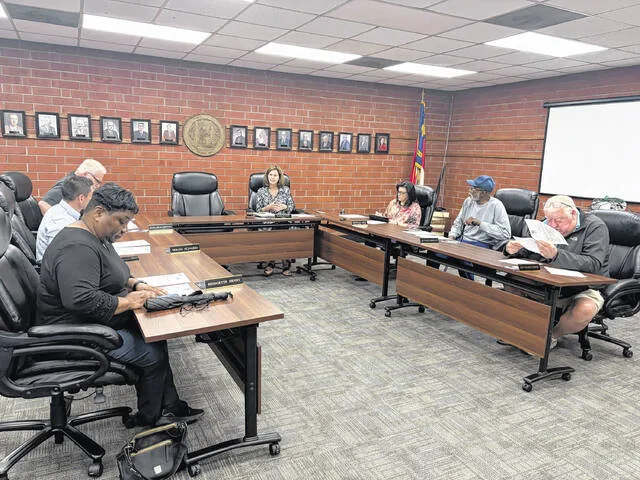
Roseboro town officials discussed whether to accept the 2026 Wastewater Treatment Plant Award it recently received, one that would allow upgrades to the 1995 treatment plant through a combination of grants and loans. No decisions were made, but the mayor urged board members to think about it and be ready to make one at the town’s regular Oct. 13 meeting.
Mayor Alice Butler explained, as she presented the cost breakdown to the board, that this was the fifth time the town had applied for this grant, and with a wastewater treatment plant built in 1995, Roseboro needs the repairs this grant would allow.
Grants, she said, work on a point system. “We applied with 60 points and got all 60.”
Butler told the board she had received recommendation to split water and sewer payments, and that supplementing water money to help sewer could be an option for making this payment plan work for the town.
“That’s a board decision, but in my opinion we’d have to,” the mayor noted.
“Expenses change every year,” Commissioner Ray Clark Fisher commented, as the board looked at the cost breakdown.
“Where are the points coming from, and do we have to stay at 60?” Commissioner Bridgette Henry asked the mayor.
“No we can drop down to 48,” Mayor Butler replied.
“How difficult?’ Henry asked, “would it be to accomplish what we need with the 48 points?”
“I think we can and that’s why we met with the project manager,” the mayor stressed, explaining that the project manager gave recommendations of what could wait and what needed the upgrade the most, along with what the town could do on its own to lower the total.
“We don’t want to do general fund,” the mayor stressed, when naming options of how the town could repay the debt it will incur with this project.
“We’re looking at this not happening for two years. It’s such a process,” Butler added, sharing that the projected start date for the repairs to the plant wouldn’t be until late 2028.
“There is the potential to break this down into contract 1 and contract 2,” the mayor added, sharing that “we know we’re going to get a $300,000 legislative grant. I don’t have the paperwork, but the senator has called and told me we’re getting it.”
“Don’t worry about the reimbursing just get it done,” Fisher urged.
Butler then explained certain things the town could do on its own, like the clarifier, to lower the total cost, but said that then impacts the total points that must be met to receive the funding.
“That’s where the point comes in. If we leave it in the project, it contributes to the points,” the mayor stressed.
“You may can’t get this again. It’s a hard task to get,” Fisher pointed out.
“Things have just skyrocketed since Covid,” Butler stressed, as she and the board discussed whether projected costs of each of the components were fair.
The mayor reminded the board that “anything over $90,000 you’re supposed to get three bids on,” and that she believed the total cost would drop some.
She also added that she had asked: “is surveying really needed?” The answer, she said, had been no, “if no digging ,then we won’t have to have surveying.”
“I believe some of these numbers will be lower — it all comes down to what y’all think we can afford,” she continued
“How much would water and sewer have to be raised to cover that payment?” Fisher asked.
“You’d have to double sewer,” the mayor replied.
“It’d have to go up from 32,000 to 47,000 a month, so it would go up about 1.5 percent,” Fisher responded
“You’re right,” stated Mayor Butler.
“Water and sewer are supposed to be self-sustaining,” added the mayor.
At that point, Fisher replied: “use the general fund,”
“That’s frowned upon,” Butler stressed, adding she believed the town could get this closer to $3 million.
“Numbers are 10 percent higher than the last grant we applied,” the mayor added, to which Fisher stressed: “you better do it now.”
“This didn’t come easy,” the mayor emphasized, adding that all this will have to be approved by the Local Government Commission.
She concluded the meeting saying she was hearing the board thought taking care of the clarifier on their own would be the right decision, but since they could’t take official action the board did not vote on it. The mayor told the board she would get more information about the points and urged the board, “At the Oct. 13 board meeting we will take a vote and get moving because we need to get moving.”