
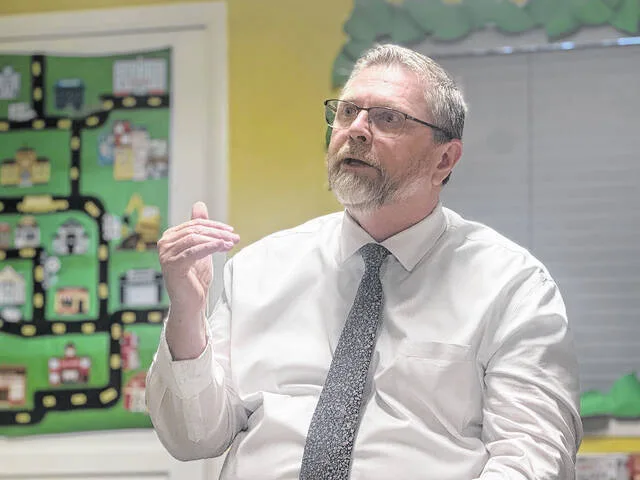

GARLAND — The first of four informational meetings giving county officials a chance to answer questions about a 0.5 percent sales tax referendum that Sampson voters will decide on during the Nov. 3 election was held in the southern county town Thursday night, with five residents in attendance.
The informational session, dubbed “Let’s Talk About Sales Tax Referendum,” was held at the Miriam Lamb Memorial Library and led by County Manager Allen Vann, along with Commissioners Lethia Lee and Thaddeus L. Godwin. Among the five residents in attendance was Garland Mayor Ralph Smith Jr.
A 0.5 percentage-point increase is being proposed, which would move the current Sampson County sales tax rate from 7 percent to 7.5 percent. The additional tax revenue would be used to help pay the county’s existing school construction debt, which exceeds $100 million.
If the sales tax increase is approved, it would go into effect July 1, 2027, according to information county officials said they received from the North Carolina Department of Revenue. None of the residents who attended the community meeting voiced opposition to the referendum.
As Vann explained during the meeting, “(The Board of Commissioners) felt it would be important to apply that money towards the $100 millions-worth of debt that we currently have for prior new construction with schools that have happened over the years.
“This 0.5 percent sales tax would be expected to generate about $4 million revenue total during the course of the budget year,” he clarified.
“The tax would not be on things like groceries, gasoline, or prescription medications,” he assured the group of residents.
Godwin emphasized that the additional sales tax would not fall solely on Sampson County residents but also on anyone traveling through the area who makes taxable purchases. Godwin referred to it as a “sharing among everyone.”
“Again, this helps to alleviate the burden on the property owners,” Godwin stressed.
Mayor Smith inquired, “Is there a timeline on (when) this debt will be paid off with this tax?”
Lee shook her head in the negative, noting, “You won’t have a lifetime to see all of that debt being paid.”
Vann concurred that the tax would be in effect for “quite a few years.”
“I think it’s a good idea,” Smith stated about the sales tax increase, “because sales tax is a fair tax; and with sales tax, take this community here … we’re one the biggest farming communities — if not the biggest — in the county.”
Smith added that the sales tax increase won’t be a hard sell for him.“As a matter of fact, I think it should be more than it is,” he said.
Jo Strickland, a Garland resident and a former town commissioner, agreed with Smith about a higher increase.
“I’m on board,” she stated. “Beats the heck out of paying more property tax, for me.”
Smith and Strickland both spoke of their support for a full 1 percentage-point increase rather than 0.5 percentage points.
“What a wonderful thing to be able to hear you see it, to go to one percent. Even though we couldn’t get that,” Godwin said. “But it’s good to hear that people can see it.”
Vann specified, “Because it’s government-issued bonds, it’s not you like you can double-down on the debt and pay it off.”
“Nobody wants anymore property tax,” Smith noted.“The 0.5 percent … is such a drop in the bucket in the big picture, I don’t think it should be that hard to sell,” he added, referring to the referendum.
To that, Lee encouraged, “Go back out and spread it in the communities to let people know it’s not a big, bad fair. It’s something that’s going to help us all in the long run,” she said regarding the community’s future.
“As long as they don’t go in there and tap this money for something else,” Strickland cautioned, “then I’m gonna be jumping up and down.”
Vann, Godwin and Lee all assured attendees that the Board of Commissioners included language in the sales tax resolution stating that the proposed increase would be used only toward existing school construction debt.
Three more informational community meetings are scheduled this month before the election. The next meeting will be held Thursday, Oct. 15, at Newton Grove Town Hall, followed by one in Clinton on Oct. 22, 6:30 p.m., at the Agri-Exposition Center and another on Oct. 29, 6:30 p.m., in the Lakewood High School media center. More information on the referendum can be found at www.sampsoncountync.gov.