
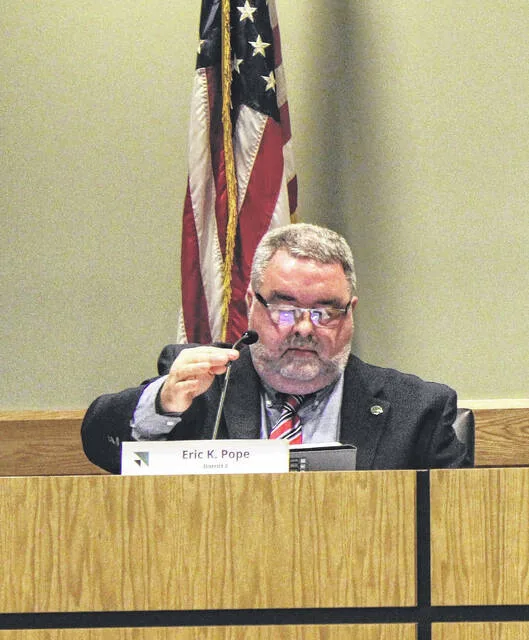
Sampson County Commissioner Eric Pope is urging voters to do their homework before deciding the fate of a proposed constitutional amendment dealing with local property taxes, cautioning that the relatively simple question appearing on the Nov. 3 ballot carries implications that could last for decades.
Pope said he isn’t telling residents how to vote. Instead, he wants them to understand what a vote for the amendment would actually do — and what it would leave for state lawmakers to decide later.
“I’m not going to tell people how to vote,” the District 2 commissioner, a Republican, stressed during Monday’s Board of Commissioners meeting. “When it comes to changing the state constitution, every citizen, that’s their individual responsibility to research how it’s going to impact them and their family down the road, the generations that they leave behind.”
House Bill 1089, now Session Law 2026-5, places the proposed amendment before voters statewide. The ballot question asks whether voters favor a “Constitutional amendment requiring limits on property tax increases by local governments.” It will appear on the Nov. 3 ballot.
Early voting begins Thursday, Oct. 15.
The constitutional language behind that question would direct the General Assembly to enact laws “limiting the amount by which the levy of taxes on property may increase,” with lawmakers also permitted to establish exceptions.
In simpler terms, voters are not being asked to approve a particular percentage or dollar limit on property tax increases. If the amendment passes, the state constitution would require the General Assembly to establish those limits through subsequent legislation.
Exactly what those limits and exceptions would be has not yet been established.
That, Pope said, is what voters need to recognize.
“The language is very vague,” he stressed. “Basically, it just puts a sentence in there that says the General Assembly shall enact general laws limiting the amount by which the levy of taxes on property may increase, which may include exemptions. And that’s just a pretty broad and vague statement.”
Pope acknowledged that the idea of limiting property tax increases may sound appealing, particularly to residents who have watched inflation and increasing property values place additional pressure on household budgets.
But he encouraged voters to look beyond the immediate appeal and consider how the amendment could operate years from now.
“In theory, it sounds good,” Pope said. “I know a lot of voters are upset over past reevaluations, inflation impacting prices, causing things to go up. … But I think they need to look past a knee-jerk reaction. Something that sounds good initially — but what are the long-term implications? Not just within the next year or two, but five, 10, 15 years down the road.”
Supporters of the amendment have argued that requiring limits could provide additional protection for property owners by restraining how quickly local property tax levies can increase.
Pope’s concern centers more on who should establish those limits.
Currently, Sampson County commissioners adopt the county budget and set the property tax rate, making those locally elected officials directly accountable to county voters for their decisions.
Under the amendment, commissioners would continue making local tax and budget decisions, but the General Assembly would be required to establish limits governing increases in property tax levies.
Pope questioned whether that authority should be expanded at the state level.
“If they’re not happy with me or any other commissioner and the way that we regulate taxes, they have the capability to vote us out,” he said about local voters. “And it’s done by people who are local, who know the impacts of the taxes. They know the services that are impacted, and not by groups spread across the state who have no direct knowledge of what’s impacting Sampson County directly.”
Pope said the issue also goes beyond whichever political party happens to control the Legislature today.
“It doesn’t matter which party is in control in Raleigh,” he told fellow commissioners. “Is it going to meet the local needs?”
He expanded on that concern during a subsequent interview.
“You don’t design a job around a person, you design a job around a function, not who’s gonna be in that position,” Pope explained. “Same thing with this. Whoever controls the General Assembly controls the property taxes.”
Pope said statewide limits could also create challenges because the financial circumstances of North Carolina’s 100 counties vary considerably.
“When it gets to individual budgets, a broad brush at the state level won’t address a lot of concerns,” he said.
As one example, Pope pointed to unfunded mandates — requirements imposed on counties by state or federal government without sufficient funding accompanying them.
Inflation could also drive up the costs of existing county operations.
If a county reached whatever levy limit lawmakers eventually establish while its expenses continued to rise, Pope said commissioners could be forced to find savings elsewhere.
“If we don’t have the ability to address that, then we have to cut into our existing revenue, which means we have to cut out services,” he said.
Some of those services may not be legally required, but Pope noted that county residents have come to expect them.
“They don’t necessarily want their taxes raised, but they don’t want to do away with those services,” he said. “Commissioners have to do a lot of balancing tests with that, balancing as to what the voters are willing to pay for versus the services.”
That is why Pope believes local officials should retain significant flexibility in those decisions.
“Your county commissioners at the local level probably have a better feel for what’s going on in that county,” he said. “Every area in the state is different — different needs, different expectations.”
There is also an important distinction between a property tax rate and the levy addressed by the proposed amendment.
The tax rate is applied to taxable property values. The levy concerns the amount imposed through property taxation across the tax base. That means property tax collections can increase as taxable property values increase even without a corresponding increase in the tax rate.
The amendment does not place a specific maximum tax rate into the constitution. Instead, it would require the General Assembly to enact laws limiting increases in property tax levies.
Pope said he supports transparency when counties make those decisions and believes state lawmakers could require additional disclosure without waiting for the constitutional amendment.
One example, he said, would be requiring counties to prominently disclose the revenue-neutral tax rate following a property revaluation, giving residents a clearer picture of how the rate adopted by commissioners compares with the rate calculated to maintain roughly the same level of property tax revenue.
“I believe in giving the information to the public, being open about what’s going on,” Pope said.
While he has not yet gone through a countywide revaluation as a commissioner, he said he already knows what information he would want Sampson County residents to receive.
“I would want the public to know what the revaluation revenue-neutral rate is, so they know if they’re paying a true tax increase or not,” he said.
The issue also intersects with another question Sampson County voters will encounter Nov. 3 — a separate half-cent local sales tax referendum for education.
Commissioners have previously discussed the possibility of reducing the county’s property tax rate if that referendum passes and generates additional revenue.
Asked whether the constitutional amendment could affect the county’s ability to make such a reduction, Pope said the amendment does not provide enough detail about what lawmakers would eventually enact.
“The only thing that this amendment does is give authority to the General Assembly,” Pope said. “The General Assembly has not said what limits they’re going to do, what actions they’re going to do.”
The proposed constitutional language deals with limiting increases in property tax levies and does not prohibit a county from lowering its property tax rate.
Pope also stressed that his concern should not be viewed as blanket criticism of state lawmakers.
“The Legislature has done some good things for Sampson County,” he said. “I don’t question that, and I appreciate the things they have done.”
But he wants voters to consider whether they are comfortable changing the state constitution before knowing the details of the limits lawmakers would subsequently establish.
“Do you want to maintain local control over your commissioners, or do you want another governing body to oversee this?” Pope asked. “That’s what you have to ask yourself.”
If a majority of voters statewide approve the amendment, the new provision would become part of the North Carolina Constitution and the General Assembly would be directed to enact the laws establishing the limits. If the amendment fails, that constitutional requirement would not be added.
Pope said the permanence of a constitutional change is why voters should consider more than the current political environment in Raleigh.
“Ten years from now, maybe different control. Thirty years from now, there may be a third party. I don’t know,” Pope told commissioners. “But the decision you make today … can have longstanding implications, and you need to understand that when you cast your vote for this constitutional amendment, for or against it.”
For Pope, that is ultimately the message he wants voters to carry into the voting booth.
“Before people make a knee-jerk reaction, they need to look at long-term implications,” he said. “They need to say, ‘Do I feel comfortable in doing this or not?’ and go with their heart and make the right choice.”