

Poverty does not always announce itself.
Sometimes it looks like an older adult living on a fixed income who can no longer safely navigate the steps outside a home. Sometimes it is someone whose health changed unexpectedly and who suddenly needs a wheelchair. And sometimes the difference between being confined inside and having a way out is several hundred dollars worth of lumber.
Pastor Clay Carter and Dr. Tommy Newton have seen those circumstances firsthand across Sampson County.
They have also decided to do something about it.
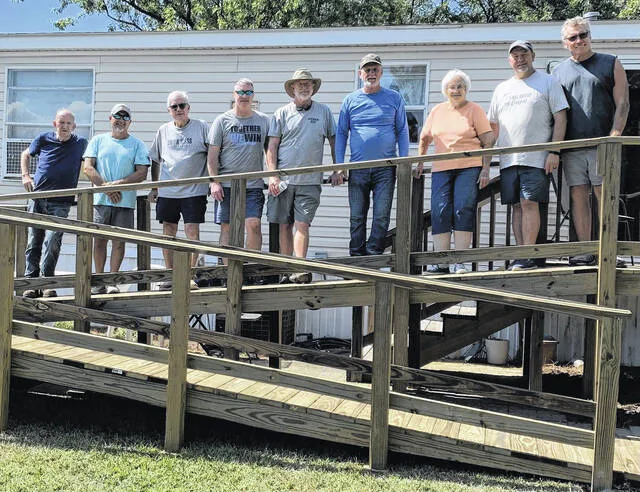
Through Sampson Ramp Ministry Inc., Carter, pastor of Rowan Baptist Church for the past 10 years, and Newton, a retired family physician who practiced medicine in Clinton for nearly 40 years and is now dedicating much of his time to ministry, are joining with churches and volunteers to build wheelchair ramps for people who, otherwise, may have nowhere else to turn.
For both men, the work is rooted in their Christian faith and a conviction that ministry does not always happen within the walls of a church.
“Jesus, of course,” Carter said when asked what moved him toward the work. “We have so many people in our community, our county, that are living in some dire straits. But we also have an increasing elderly population. The baby boomers are getting older.”
Carter enjoys building, and he has found others, including Newton, who are willing to put their hands to work alongside him.
“It’s our ministry,” Carter said. “We’re not getting compensated anything for it. It’s a ministry. We’re the hands and feet of Jesus.”
Newton’s path to the ministry is different, but the desire to serve is familiar.
For close to four decades, he practiced family medicine in Clinton, a profession he viewed as a form of service. Retirement has given him more time to continue that calling in another way.
“I’ve always kind of had a heart to serve others,” Newton said. “Now that I’m retired, I have more opportunity to serve people in different ways.”
There is another connection for Newton. Some of the people receiving ramps are former patients or relatives of people he once treated.That has turned some projects into reunions.
“A lot of times when I see people like that, we kind of cry together,” Newton said. “I felt like I was a part of their family a lot of times when I was taking care of them, and we’ve been through a lot of life’s stressors.”
Building ramps has allowed him to reconnect with those families, he said, while fulfilling Christ’s commandment to love one’s neighbor.
A need close
to home
Many of the referrals Carter receives come through the Sampson County Department of Aging.
The department has needs of its own to contend with, including limited resources and more requests than can always be immediately met. Others hear about Carter through friends or relatives of people who previously received a ramp.
The ministry is not restricted to members of a particular church or denomination.
“It’s for everybody who has a need,” Carter stressed.
That need can stretch across the county and sometimes beyond it. Carter and Newton recently helped construct a ramp just over the Johnston County line for a church member of a pastor Carter knows. In another connection that illustrates how intertwined their work can become, the recipient’s daughter had been one of Newton’s longtime patients.
But their primary focus is Sampson County, where Carter and Newton say poverty creates a significant barrier for people who need accessibility improvements to their homes.
Carter said information he received from the Department of Aging showed a county poverty rate of about 19 percent, with substantially higher rates in some portions of Sampson.
Those numbers matter to the ramp ministry for a simple reason: Labor may be free, but lumber is not.
A person who needs a ramp may be unable to afford $800, $900 or $1,000 in materials, particularly someone who is elderly and living on a fixed income.
That reality is one of the primary reasons Sampson Ramp Ministry Inc. was established as a nonprofit organization — to raise money for materials so a person’s inability to pay does not automatically become an inability to receive help.
Newton recalled a ramp the group built about a month ago near Midway Middle School. It stretched approximately 40 feet.
The man who needed it, Newton said, had been waiting about a year.
“The need is just so great,” Newton said. “That’s why we started this nonprofit — to help raise funds to try to fund materials for these ramps.”
For Carter, those situations also challenge a common perception of what poverty looks like.
“You don’t have to go to Panama or Nicaragua or Haiti to see poverty,” Carter said. “There’s poverty in Sampson County. It just looks different.”
Newton agreed.
He has participated in international outreach, including Operation Christmas Child, and stressed that there is value in mission work abroad. But he believes Christians also have an obligation to recognize suffering outside their own doors.
“You don’t have to travel out of Sampson County to be able to do the Lord’s work,” Newton attested.
After caring for local families for decades, Newton already knew those needs existed. Retirement has simply given him another way to respond.
“I just feel like that’s the way the Lord is leading me to serve…here,” he said.
Churches
working together
Sampson Ramp Ministry is beginning that effort with support from eight churches that have agreed to provide seed money.
Newton said organizers approached churches where they already had relationships and found widespread support for the idea. Some congregations already perform similar outreach individually, but the ministry offers an opportunity to pool resources toward a countywide need.
Carter and Newton hope that circle grows.
The Rowan pastor believes that if churches throughout Sampson County contributed according to their ability, the combined effort could dramatically expand the number of people the ministry serves.
“If we could get the participation of every church in Sampson County, we would have the funds,” Carter asserted. “I’m going to go out on a limb in faith and say we would have the funds to meet the needs in this county.”
Newton shares that optimism, although he recognizes congregations vary greatly in size and resources.
“There are a lot of small churches, particularly out in the county, who wouldn’t financially be able to give as much as some of the bigger churches,” Newton said. “But that’s all right.”
Support does not have to look identical from every congregation, he stressed. What matters is participation and a willingness to work together.
“I think we could make a big dent,” Newton said.
That phrase — making a dent — captures what both men acknowledge is the realistic scope of their undertaking.
Neither claims a wheelchair ramp ministry can eliminate poverty in Sampson County.
When asked whether he believed the county’s poverty rate could eventually decline, Carter hesitated. The question, he said, was bigger than he could answer.
“I just know where we are right now,” Carter said. “The reality of where we are right now.”
Newton described poverty as a “multifaceted problem,” one far larger than any single ministry, church or organization can solve.
But solving everything, he said, is not a prerequisite for doing something.
“We can make dents in certain places,” Newton said. “God gives us skills and gives us the motivation to do different things. And this is, I think, one area where we can do His work.”
They may not solve poverty, Newton added, but they can “put a big, big dent” in one particular problem and serve many people along the way.
Seeing the person
Behind the statistics and lumber costs are people.For Carter, that remains the heart of the ministry.
“It’s about seeing other people, seeing people, caring, being compassionate,” he said. “That’s a lot of it. Just seeing their need.”
Most people they encounter are grateful for the assistance, Carter and Newton said. Occasionally, however, Carter has met elderly residents hesitant to have a ramp installed where everyone can see it. Some have asked whether it could be placed behind the home instead.
In those situations, Carter talks with them about safety and the consequences of a fall, particularly for an older person who could face a lengthy recovery from a broken hip or other serious injury.
But those situations are rare, he said.
“People are just so thankful and grateful that someone is helping them,” Carter said.
Newton estimated that virtually everyone he has encountered through the ministry has been overjoyed to receive assistance, particularly those who have waited months for help.
And disability, the men stressed, is not limited to the elderly.
Carter recalled building a ramp for a younger man who had been healthy and working as a mechanic before a cat bite led to an infection and paralysis. Suddenly, the man needed a motorized mobility device and a ramp simply to enter and leave his home.
“He never knew that was going to happen,” Carter said. “You never know what you might run into.”
That unpredictability reinforces something Carter and Newton want people to remember: Today’s volunteer, donor or neighbor could one day be the person who needs someone else to lend a hand.
For now, they intend to keep lending theirs.
Carter sees Sampson County as his mission field — his “Jerusalem” and “Judea,” borrowing from the biblical call to begin serving close to home.
“The need is here, and the need’s not going to go away,” Carter said. “We can’t brush it underneath the rug, and we have to help in any way we can help. If we don’t, people are going to be going without.”
For Sampson Ramp Ministry, making a difference does not require eliminating every hardship in the county.Sometimes it begins with a few volunteers, some lumber and a willingness to notice the person on the other side of the door.
One ramp at a time, Carter and Newton believe they can make that dent.