
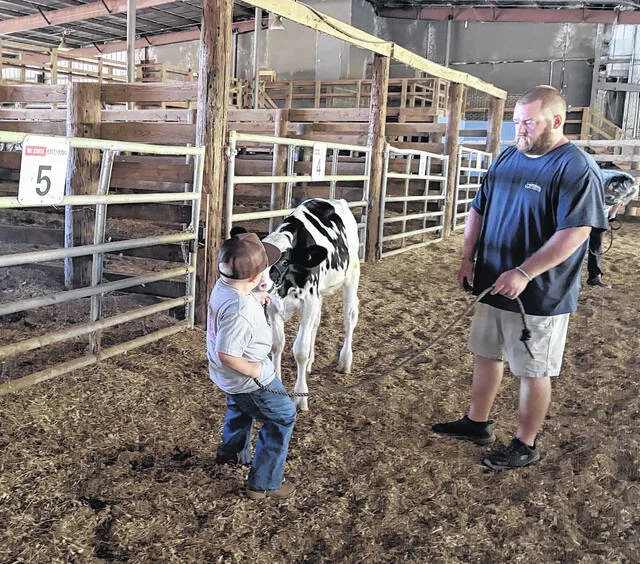

The Sampson County 4-H Dairy Club met Tuesday, Oct. 6, with kids, ages 5-18, being taught to be “beyond ready,” each week through a hands-on livestock experience.
“Beef cows are a little more unpredictable than dairy cows,” noted Elizabeth Merrill, Sampson County 4-H program assistant.
“A little?” Layla, the oldest of the group and a veteran when it comes to showing livestock, responded.
“Remember they’re herd animals,” Merrill reminded the group, adding, “they don’t like to be left alone. The 4-H leader shared that last week one child and his cow were left alone in the arena after the others had left, and the cow got spooked.
“Loose cow, loose cow,” could be heard in the barn as the 4-H assistant calmly alerted the kids that one of the cows had become untied.
“Good job, good,” Merrill praised the kids as they quickly and calmly wrangled the free cow.
4-H is a national program, Merrill reported, explaining that it’s in all 50 states and U.S. territories like Puerto Rico.
Seven million youngsters, ages 5-18, are involved nationwide, with 70,000 active in chapters across North Carolina. Its first presence in N.C. dates back to 1902 in Hertford County, starting as a tomato club. Merrill was excited to share that some of the oldest roots of N.C. 4-H include Sampson County as well, with origins at Mingo Hill Crossroads in Spivey’s Corner, which began as corn and tomato clubs.
“4-H is building future leaders,” Merrill stressed, sharing that the organization’s goal is to make kids “beyond ready,” which is the theme for this year’s National 4-H Week.
National 4-H Week was observed from Oct. 4-10. Dr. Shannon McCollum, interim state 4-H program leader, described the week as “always one of my favorite times of the year because it gives us a chance to celebrate the remarkable achievements of our youth and the dedicated parents, leaders, staff, and volunteers who support them every single step of the way.”
4-H is grounded in agriculture but incorporates S.T.E.M. (science, technology, engineering, and mathematics) too, Merrill explained, sharing that Sampson competed in the “Game of Drones” at state competition for the first time this year and were resident champions. She went on to say that drones are used in farming for crop monitoring and irrigation, making it a natural inclusion in 4-H, and that the game of drones provides students opportunities to develop problem-solving and teamwork skills.
For the heifer project, Merrill described the responsibilities kids (and their parents) have. “Kids come twice a week, and volunteer for a weekend (to feed the cows), Merrill shared. The program assistant has been involved in 4-H since childhood herself, “26 years total. I grew up a 4-H-er in Wayne County,” Merrill said with a smile. Once she was old enough, her involvement “spilled over into volunteering,” which, she stressed, was because she wanted to give the same passion she had for 4-H to kids today.
Merrill has spent 11 years with Sampson Cooperative Extension, and named the self-driven and independent nature of 4-H projects as so important and educational for life. “Kids have to make the commitment,” she shared.
Merrill described the things she had been practicing with the kids in the dairy project. “They learn how to tie up the animals. We go over quick release knots and such,” she emphasized.
“It’s definitely a family activity,” Merrill stressed. “We do a little bit of everything,” the program assistant added.
After the kids worked with their cows some, leading them up and down the aisle, brushing them, and practicing their knots as they tied them to the stall gates, Merrill led the kids to the end of the barn for a lesson on breeds. “I try to do something educational each time,” Merrill stressed.
The program assistant held up pictures of different breeds of dairy cows, asking the youngsters to identify what breed each cow was, and giving them some information about each, reminding them that whoever gets the most right at the competition will win a prize.
“The judge is going to ask you,” she reminded the kids, helping them enunciate when pronouncing Jersey and Guernsey.
“Which breed are your cows?” Merrill asked the group. “Holstein,” they all shouted.
After reviewing breeds, it was time for the cows to be returned to their stalls and for the kids to feed them. They loaded a wagon with bowls of feed for each cow, delivering each to the cows in their stalls.
Kaela Watts, whose two daughters are involved in 4-H, shared her gratitude for the organization. “We just discovered 4-H this summer, she explained, “it’s teaching kids so many things.”
Watts added: “It’s something the community needs and I wish more people would get involved,” she stressed, adding, “Elizabeth puts her heart and soul into it; that’s for sure.”
As the 4-Hers finished feeding the cows, they had an opportunity to problem-solve when they realized they had one less feed bowl than cows. Merrill finished the time by reminding them to “plan what you’re going to do before you do it.”