
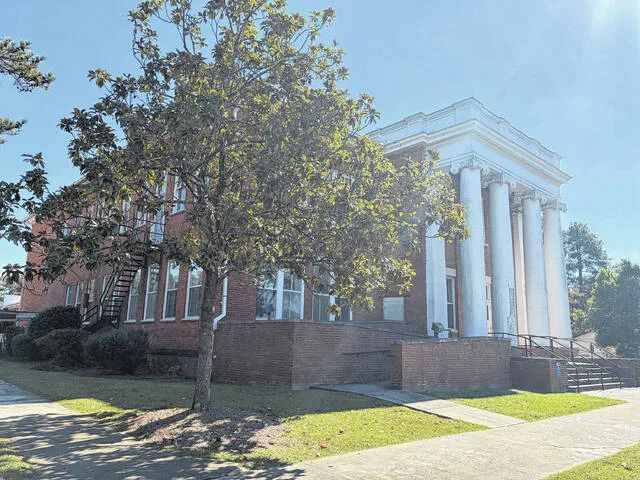
College Street School holds memories for many in Clinton, but the city school system, which owns the property, hasn’t used the building since 2019 and is ready to sell it with help from Preservation North Carolina, a nonprofit dedicated to preserving historic properties, in hopes of finding a new purpose for the longtime school building.
Earlier this month, in a phone interview, Clinton City Schools Superintendent Dr. Wesley Johnson reported that district officials had met with five to 10 different developers to determine a plan. With significant repairs needed to the upstairs portion of the building and the hope of preserving the history it holds, the district turned to Preservation N.C.
“We don’t use the building, but our hope is it could be turned into apartments for young educators,” Johnson stressed of the district’s vision for the property.
“Preservation NC will be like the broker or the real estate agent,” the superintendent explained, adding that “we’re basically already moving forward. Everything is good with the document, and next the appraisal is needed,” Johnson said, sharing that the appraisal is expected to be obtained within the next 60 days.
Once the appraisal is finalized, the property must first be offered to the Sampson County Board of Commissioners, as required by North Carolina General Statute 115C-518.
Under the statute, when a school board determines that property is no longer needed for public school purposes, county commissioners must be given the first opportunity to obtain it at fair market value or a price negotiated between the two boards. Proceeds from a sale or lease exceeding one year must be used to reduce applicable county school debt or for capital outlay purposes.
Johnson explained that the property includes seven acres of land, with the main building as well as another building behind it.
“What I have gleaned is several developers do this on the regular,” Johnson said of preserving historic properties.He added that he was confident any developer selected would be experienced in restoring historic properties, with Preservation N.C. helping ensure that preservation remains a priority.
“Without a doubt we want to see that building restored,” Johnson stressed, again sharing his and the board’s hopes for apartments, possibly one-bedroom units or studios, for beginning educators or other young professionals, including firefighters and police officers.
“I haven’t personally been in the apartments above R&R but possibly something similar,” Johnson added, acknowledging the memories College Street School holds for the town and his excitement about working with Preservation NC to maintain that history.
At the end of September, John Lowe, Clinton City Schools director of technology and Auxiliary Services, provided additional context for the district’s process for selling College Street School and the different uses the building has had over the years.
Lowe explained that the Clinton City Board of Education owns the property, stressing that it “is rare for the board to own” a school building.
The first step is obtaining a clear title, “which we have a firm assisting with that,” Lowe stated.Once the title work and appraisal are completed, the district will contact county commissioners to give them the first opportunity to purchase the property.
There is “no designated timeline at this time,” Lowe reported, adding that Clinton City Schools is currently leasing the building to Grace Helping Others LLC, with a one-year lease running through June 2027.
While tenants occupy the building, they are responsible for minimal rent and fees and must maintain the property, Lowe explained.
When the building hasn’t had tenants, the district has kept up with necessary repairs, such as broken windows or HVAC issues, while paying utilities and maintaining the grounds.
“We used to have some of our Pre-K at College Street, but when Dr. Johnson became superintendent in 2019 he wanted all Pre-K to be housed at L.C. Kerr,” Lowe explained, adding that Johnson believed it made more sense administratively to have all pre-kindergarten classes together, rather than requiring administrators to travel between two campuses.
Before housing Pre-K classes, College Street School served as the district’s central office.
Lowe also reported that community focus groups had been held to gauge interest in the property, which helped lead to Preservation NC’s involvement.
With College Street and the school itself listed on the historic register, there are restrictions on what can be done with the property. Those restrictions, along with the district’s intention of preserving the school’s history, have helped guide the process.
Its History
In “Clinton City Schools Past, 1821-Present, 2012,” compiled by Sue Cannady Barefoot, College Street School’s history dates back to 1826, when Clinton School Academy was founded at the site of the present-day school. The academy began as a private school funded by members of the community.
In 1892, the school acquired a new name, Clinton School for Boys and Girls, which opened Sept. 5 of that year at the current College Street site.
In 1900, Clinton Graded School became a public institution that included grades one through 11.At the time, the school was housed in a large wooden-frame building on College Street. According to the National Register of Historic Places inventory form, “…in 1911 the present structure, a handsome, large, two-story building with a center bay pediment portico of Ionic columns, replaced the original frame building.”
This is the current structure seen today, as corroborated by Johnson and Lowe.
However, “The Sampson County Heritage Book,” Vol. 1, page 101, states that additions and changes were made to the wooden structure and the entire building was brick-veneered.It remains unclear whether the building that stood before 1911 was demolished and replaced or refurbished to resemble the current structure. No other records could be found, according to Barefoot’s history of Clinton City Schools.
According to the State System of Public Schools 1920-22 Biennial Report, the College Street School building was renamed Clinton Elementary School and contained grades one through seven. The upper grades were moved to a newly constructed building on Sunset Avenue called Clinton High School.
An article in the 1947 Clinton High School annual recalled that “in the year of 1935 a group of boys and girls, rather shy as they hugged the skirts of their mothers, entered that large building on College Street known as Clinton Grammar School.”
In 1954, Clinton Grammar School was renamed College Street School when Kerr School was built for the lower elementary grades.
Over the years, the building continued serving the district, eventually housing central office operations and later prekindergarten classes.
Now, with major repairs needed upstairs and no plans for the district to use the building again, officials hope its next chapter will preserve the history that remains important to so many in Clinton.
Lowe and Johnson both pointed to the school’s historic designation and its ties to the community as reasons for working with Preservation NC.
The organization is the state’s only private statewide nonprofit dedicated to historic preservation, and Johnson is confident that, with its help, the right developer can be found to restore the school and maintain its history, with the hope of housing young educators or other professionals in the years to come.