
Leonard Henry still carries Clinton with him.
He carried it through the recreation department, where his generation of Dark Horses first learned what competition felt like. He carried it through middle school, where winning became an expectation and pride became part of the uniform. He carried it into high school, to East Carolina University, to the NFL, overseas and across locker rooms filled with some of the best football players in the world.
And when the lights of football began to dim, Henry carried Clinton into a new calling.
Today, the former Dark Horse standout, East Carolina great and NFL running back has returned home as a pastor, husband, father and community voice. His journey has taken him farther than most young athletes, but to hear Henry tell it, the foundation was never complicated.
It was Clinton.
It was family.
It was pride.
It was hard work.
“My parents always instilled in me hard work,” Henry reflected during a Friday morning interivew. “One thing we pride ourselves off of here in Clinton is just working hard. We never really tried to be popular. We never tried to be cute, but we were always hard workers. We just knew how to grind.”
That word — grind — surfaces often when Henry looks back.
Before the college scholarship, before the NFL Draft, before he heard his name called by the Miami Dolphins, there was the Clinton Recreation Department. There were older players he watched and admired. There were names that carried weight around town: Jerris McPhail, Fuzzy Lee, Scooter Banks, Randy Barefoot, Raphael Smith, Brian Peterson and others.
Those were not just names to Henry. They were examples.
“Growing up around here, you bleed football,” Henry remarked. “Basketball is great. Soccer is cool. Baseball is cool as well, but around here, in Clinton, this is football.”
Henry grew up watching those athletes, studying them and wanting to follow their path in his own way. Clinton’s recreation system, he explained, was more than a place to play. It was where young athletes were tested. It was where they learned that talent mattered, but toughness mattered more.
Everybody competed. Everybody wanted to outwork somebody.
“It was kind of like iron sharpens iron,” Henry asserted.
That edge carried into middle school. He remembered walking past the trophy case and seeing the standard left behind by the group before him. They had gone undefeated, and Henry’s class wanted to do the same.
“That was our motto,” he recalled. “We wanted to be undefeated just like them, and we knew that it wasn’t going to fall out of the sky. We had to work.”
They did.
Henry noted that his middle school teams never lost a football or basketball game during seventh or eighth grade. Those seasons became part of his foundation, but they also became part of the larger Clinton standard.
“Taking pride in what you do — that was always big,” the now pastor stressed. “Never let no one question your work ethic. They may question some of the decisions that you make, but never let them question your work ethic.”
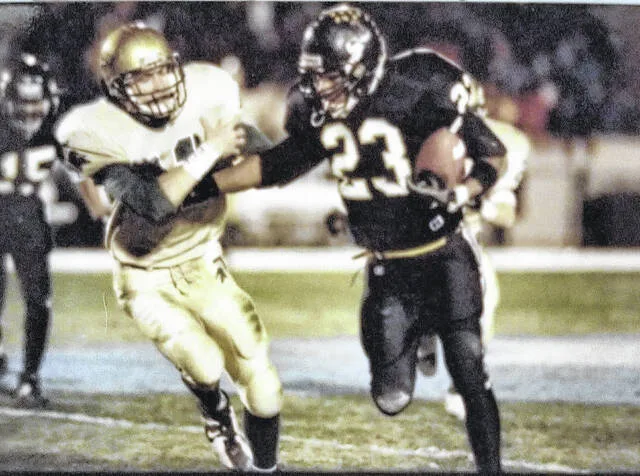
By the time Henry reached Clinton High School, the talent was already there. The chemistry had been built through recreation ball, middle school, street games and the legendary Turkey Bowl around Thanksgiving, where younger players matched up against older players in raw, padless football.
There was no hiding in those games.
“The old-school players … they might not have been as fast, but if they ever got their hands on you, they were going to rough you up,” Henry laughed, recalling those games. “They were going to toughen you up.”
That toughness helped shape a generation of Dark Horses. By the time they put on the Clinton uniform, Henry said the players already knew one another’s strengths, weaknesses and tendencies. They had competed against one another for years. Now, they were finally together.
“When we put on that Dark Horse uniform, everybody laid aside all that stuff and we became one,” Henry explained. “All we cared about was winning. We didn’t care who got the glory. We just wanted to hoist the trophy.”
For Henry, the mission became even sharper after Clinton lost to Thomasville in the state championship game during his junior year. He was named defensive MVP for the losing team, but the honor brought little comfort.
Walking off the field, with Thomasville celebrating, Henry made a promise.
“I looked at some of my classmates and I said, ‘We’re coming back here next year. We’re going to win this thing,’” Henry remembered.
From that moment, he said, his focus became almost frightening.
“I was so laser focused that it scared me,” he admitted. “All I thought about was football, winning, dominating. That’s all. Dark Horse pride.”
College was not always part of the plan. Henry was not focused on recruiting letters or SAT scores. He was focused on getting Clinton back to the state championship and finishing what his class had started.
It was not until midway through his senior season that he truly began to realize college football might be possible.
“I never really saw myself going to college,” Henry admitted. “All my desire was to win a state championship.”
Ironically, Henry did not even want to be a running back at first. He preferred defense. He loved contact. He loved hitting. At one point, he recalled, he would intentionally run the wrong way during offensive plays because he did not want the football in his hands.
“I just wanted to hit,” he laughed.
Eventually, there was no denying what he could do with the football. East Carolina originally recruited him as a safety, but after seeing more tape of him at running back, the Pirates changed course.
Henry went to Greenville as a running back, but the adjustment was far from easy.
At Clinton, he had been one of the strongest and fastest players on the field. At East Carolina, he quickly learned that everybody was bigger, faster and stronger. The speed of the college game forced him to grow quickly.
“It’s still football – blocking, tackling, running,” Henry explained. “But the speed by which it happens, that’s what took me a while to adjust to at East Carolina.”
In high school, Clinton’s offense was built on the run. At ECU, Henry had to learn pass protection, blitz pickups, route concepts and defensive reads. He had to understand linebackers, safeties and coverages in a way he never had before.
The transition humbled him.
His redshirt year allowed him to adjust physically and mentally. Summer school, workouts and conditioning became part of his life. Under strength and conditioning coach Jeff Connors, Henry learned how far the mind could push the body.
“The mental part of the game is just as important as the physical part,” Henry stressed. “The body might say quit, but the mind says push one more yard, push one more rep.”
Henry also carried a promise with him. His parents expected him to graduate. Football had given him a scholarship, but they reminded him the opportunity was about more than yards and touchdowns.
“My parents were like, ‘You’re doing great on the field, but what about this right here?’” Henry recalled. “The title is student-athlete.”
There were moments when Henry wanted to leave ECU. At one point, frustrated by a lack of playing time, he considered transferring. But his coaches reminded him that nothing was guaranteed.
“You just got to work hard,” Henry emphasized. “When your opportunity comes, take advantage of it.”
He did.
Henry became one of East Carolina’s top backs, earned national attention and eventually received an invitation to the NFL Combine. There, he entered what former players often describe as a football meat market — measurements, testing, drills, interviews and constant evaluation.
The dream became real during the 2002 NFL Draft.
Henry remembered receiving calls from multiple teams, each suggesting he might be their next pick. But as names came across the television screen, nothing matched what he was hearing on the phone.
Then the Dolphins called.
“They said, ‘Leonard, we’re turning our card in now. Congratulations,’” Henry recalled. “I said, ‘Man, listen, I done had calls today. I don’t believe it until I see it.’”
Then he saw it.
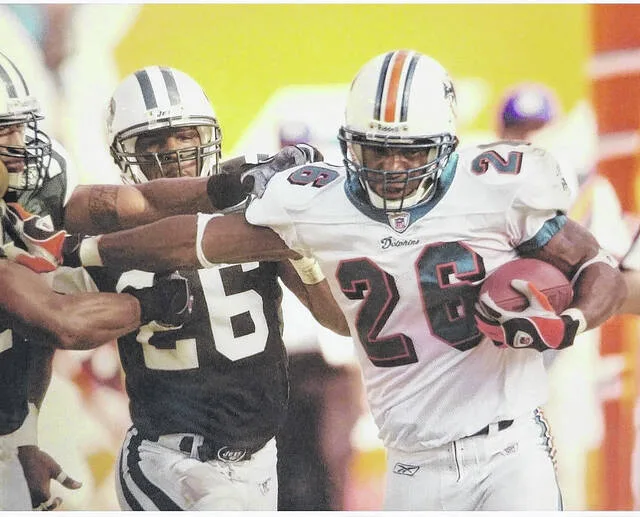
With the 241st pick in the 2002 NFL Draft, the Miami Dolphins selected Henry of East Carolina University.
“My mama busted up in that room,” Henry remembered with a smile. “Everybody was just so excited. In a matter of 15 minutes, my house was flooded with people, family and friends coming over, celebrating. This was a big moment for Clinton.”
Henry knew he was not just representing himself. He was carrying his family, his school and his hometown.
Still, he said that did not feel like pressure. It felt like support.
“I knew the city was proud of me,” Henry reflected. “Whether I went down there and was successful or failed, the city was proud of me.”
In Miami, Henry took the same approach that had carried him from Clinton to Greenville.
Hard work.
Pride.
Preparation.
As a rookie, one of his responsibilities was serving as a scout-team running back, mimicking upcoming opponents so the Dolphins’ defense could prepare. That meant studying players such as Edgerrin James and giving stars like Zach Thomas the best possible look in practice.
Henry took pride in that role.
“That was a job,” Henry explained. “You go from playing the game because you love it to now, in the NFL, it’s a job. But it’s a fun job.”
He shared a locker room with names football fans still recognize — Ricky Williams, Zach Thomas, Jason Taylor, Jay Fiedler and others. He remembers how quickly the game moved, especially the first time he saw Taylor come off the edge in practice.
“I realized then, ‘Yo, I am literally in the NFL,’” Henry recalled. “The game went from college to a whole other level.”
Henry spent three seasons with Miami, a period he still remembers fondly. But his life changed dramatically during that same stretch. His mother became ill after he was drafted and died in November 2002.
It was one of the lowest moments of his life.
“The Dolphins embraced me,” Henry shared.
Around that time, Henry’s faith also deepened. He said he gave his life to Christ, and his identity began to change.
“I found a new life, literally,” he reflected. “God got a hold of me and just radically changed me from the inside out.”
After Miami, Henry had stints with other teams and opportunities, including time connected to NFL Europe and the Canadian Football League. He kept training and stayed ready, believing another call could come at any moment.
Eventually, his agent delivered the words no young athlete wants to hear.
Retirement.
“At the time, I’m 26 or 27,” Henry recalled. “I said, ‘Man, retirement? That don’t sound right.’”
But as one chapter closed, another began opening.
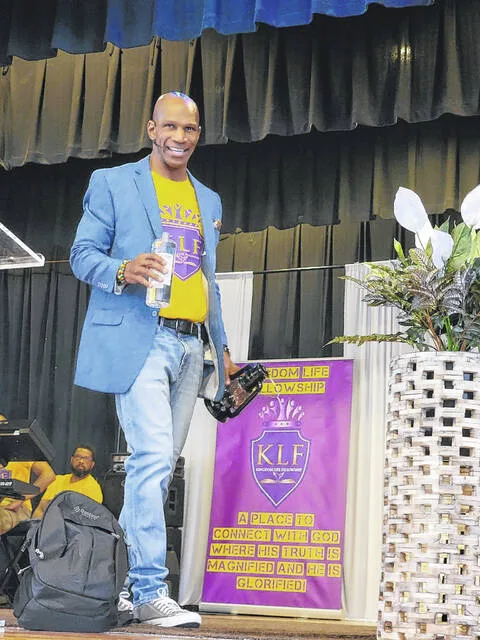
Henry began speaking at churches and youth events. At first, people invited him because of football. They wanted to hear from the former Dark Horse, the ECU standout and the NFL player. But once Henry got behind the microphone, his message shifted.
“I wasn’t talking about football,” Henry noted. “I was talking about Jesus.”
Football had been the stage, he realized. Ministry became the calling.
That calling eventually brought him back home.
“There’s no place like home,” Henry remarked. “There’s no place like this place.”
Today, he serves his community through ministry, pouring into people in a different way than he once did on Friday nights. He is still a Dark Horse. He still takes pride in Clinton. But his purpose now reaches beyond football.
“Coming back home has been everything and some,” Henry offered. “God called me back home for a reason.”
He pastors, mentors, encourages and remains connected to the community that helped raise him. He also understands the responsibility that comes with being Leonard Henry in Clinton.
There are days, he admitted, when he does not want to be the football star or the pastor.
“There’s days I don’t want to be Leonard Henry,” he admitted. “I just want to be Skinner.”
Skinner is his nickname, the version of himself known by those closest to him. But Henry also understands that influence comes with expectation.
“To whom much is given, much is required,” Henry emphasized. “I know God has given me great influence in this city and this community. With that comes a lot of pressure.”
He carries that responsibility carefully, not only for himself, but for his wife and children. He knows his children may one day feel the weight of his name, especially if they choose to play sports. But Henry does not want them trying to become him.
He wants them to become who they are called to be.
“Whether my children decide to play sports or not, I’m all right,” Henry affirmed. “I want them to be successful citizens of the community, get an education, be respectful to people, love Jesus and love church. If sports come about, that’s cool. If not, no big deal.”
Henry still has reminders of every stage of the journey. Certificates from recreation ball. Old scouting reports. Awards. Newspaper clippings. Memories packed away from a life that has already stretched far beyond what many imagined.
One day, those pieces will belong to his son.
“He doesn’t even know what he has,” Henry laughed.
But Henry knows exactly what he has.
He has a story rooted in a small town, shaped by parents who taught him to work, coaches who challenged him, teammates who sharpened him, a community that supported him and a faith that redirected him.
When asked to describe his journey in one word, Henry paused.
There were losses. There were frustrations. There were moments when he wanted to quit. There were seasons when he did not understand why things were happening the way they were.
Looking back now, he sees it differently.
“Blessed,” Henry answered after a pause. “One word – blessed. Every bit of it. Good, bad and ugly, blessed.”
That is the Leonard Henry story.
A Clinton story.
A Dark Horse story.
A story of hard work, pride, faith and a man who left home carrying his community with him – only to return home and give even more back.