
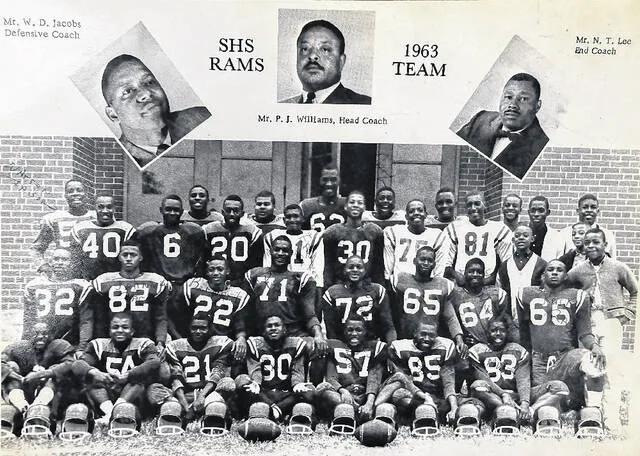
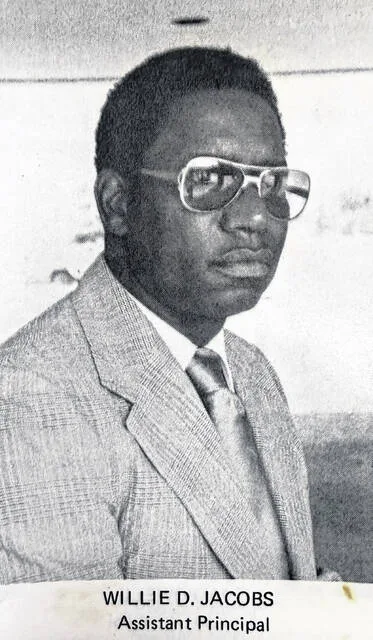
Willie Don Jacobs was an icon to the many people fortunate enough to meet him in their lifetimes. Whether they called him coach, principal, colleague, or friend, Jacobs was a memorable figure in the lives of those who knew him.
The son of Henry and Ophelia Jacobs, Jacobs grew up in Clinton. In 1949, he graduated from Sampson Training School and completed his undergraduate studies with a Bachelor of Science degree in health and physical education at North Carolina College (now North Carolina Central University) in 1954. He would later complete his graduate studies in Education Administration at East Carolina University.
He began his career in coaching at Sampson Training School first in football and later in junior varsity basketball at Sampson High School. In 1966, he helped coach the Sampson High Boys JV team to a championship, leading the team to a 24-0 record, with players such as Willie Boykin, Billy Hayes, and Clarence Underwood. He was later appointed varsity basketball coach at Clinton High School, in 1973, becoming the first African-American to hold the position, one he maintained for over 14 years. Four years later, Jacobs ended up helping the team bring home the East Central Conference AAA Basketball Tournament championship. In over 24 years of coaching basketball, Jacobs only had two losing seasons.
Outside of basketball, he would also coach boys and girls tennis from 1959-1974.
In addition to coaching, Jacobs was also a teacher, first at his alma mater in 1956. He would later move up the administrative ranks in education, becoming an assistant principal at Clinton High in 1974. He would remain in that role until 1988, ending over 32 years of educational service.
Jacobs married his late wife, Charity Williams, in December 1956. The couple had two children, Daphne Jacobs Holman and Willie Don Jacobs Jr, and later, two grandchildren, Emerald Michaela and Prince Ellington Holman.
Strong in his faith, Jacobs was a lifelong member of First Baptist Church in Clinton, serving as a Sunday school teacher as well as a member of the male chorus. In 1969, he was ordained as a deacon. For all of his contributions within the community, Jacobs was inducted into the Sampson County Sports Club Hall of Fame on Nov. 8, 2005. He passed away at the age of 87 on April 3, 2017.
“He was a good friend of the family, particularly with my older brother,” said Lenzie Grice, who played football under Jacobs from 1962-1965. “As my coach and PE teacher, he was one of the main people in my life that sort of guided me to where I am today.”
Grice, who played quarterback for four years under Jacobs at Sampson High, was among players who would go on to play in college. At Shaw University in Raleigh, Grice was inducted into the school’s Hall of Fame in 2016. But for Grice, everything could have been cut short before it began in his senior year.
“I was up for captain for the football team, and we had a curfew,” Grice explained. “I broke curfew, and when I came back into my house, I came through the back door, and he had just left out the front door. My mom told me that Bill (what some people called Jacobs) was here. I said, ‘Coach Jacobs?’ and she said yes, and that he wanted to see me. When I asked her what she told him, she told him that I wasn’t here. That Monday, I went in, and he called me to his office, telling me to bring my equipment in.”
Grice asked Jacobs why he was kicking him off the team, especially with him up for captain in his senior year.
“That’s the point,” Grice recalled Jacobs telling him. “He said, ‘If you can’t follow, you can’t lead. You can’t follow instructions; we had a curfew, and you broke it, so you’re off the team.’” Eventually I had to beg and pray my way back on the team, talked to the other coaches and players, and they voted me back in. I had to do the rookie thing, bring out the equipment and all that stuff for a couple of days, even as the big star senior. I had to do that until I got reinstated back to the team. So I carried that lesson throughout life.”
To Grice, the expectations and structure of having everyone take accountability are some of the biggest things that Jacobs tried to teach his players.
“He was a good mentor to me and other kids as well,” Grice emphasized. “If you asked him a question, he wouldn’t answer right away. He would take a few moments to take it all in, and then he would give you an answer. He was one of the main coaches that guided me to college. I was able to play good football in college, inducted into the Hall of Fame. It hurt me to my heart because he wasn’t able to go; he was sick, but he was beaming with joy (when Grice later saw him), and it was beautiful.”
Ron Moore, who played basketball under Jacobs on JV from 1967-68, was very close to the coach.
“Coach taught us a lot of things, not only on the basketball team, but he taught us different things in the community, like in the church,” he expressed. “But most importantly, he taught us how to love and serve one another. As far as things basketball-related, he taught us how to be very organized. Organization plays a big part in anything that you’re trying to do. He was a very stern person, and if you didn’t understand him, you might get the wrong impression. Coach Jake didn’t joke a whole lot, nor did he play around, even though some of his students wanted to challenge him quite a bit. He was a man who held his head up high, and he taught us how to dress for success.”
Even as a PE teacher, Jacobs would be fully dressed with a necktie and a suit along with a sport coat, according to Moore. It was only after he got into the school that he would then dress down.
“That’s one thing that I was very impressed with him about,” Moore remembered. “The way he just carried himself.”
Moore personally witnessed the 1966 JV team that went undefeated under Coach Jacobs.
“When you got a good coach and a coach that disciplines you in practice, then, when you have good players that can execute the plays that the coach wants, wins come a little simpler,” he attested. “I wouldn’t say easy; nothing comes easy, but they just had that discipline about them. Those guys were good before they got on the team, but to have a good coach that knows the X’s and O’s, it plays a big part in whatever you’re trying to do. They were big, and they were tall, at least I thought so. One player was 6 feet 6 inches, another was close to 6 feet, 3 inches, 6 feet 4 inches. But them boys could play.”
While he was spending time as a deacon at First Baptist, Jacobs showcased a different side of his personality that many may have never seen outside of school.
“I saw how humble he was, never tried to take over anything,” Jacobs recalled. “How gentle he was. In the church, it was another side of him that you didn’t see at the schoolhouse while he was being provoked by some of the other, older guys that lived in the community. They used to love to play with him because he held his head up so high. He was always like a serious-minded man, but he took that into the church, and he did very well. He always looked out for the older elders in the church.”
While talking about the memories he shared with Jacobs, like the time when Moore and his brother, Luther, missed the school bus and Jacobs helped them out by giving them a ride, Moore expressed how he missed his coach.
“I still wish he was here, to be honest with you,” he admitted.
But the lessons that Jacobs shared with them, and many across the community who knew him, stuck with them.
“He was a gentleman,” Moore said. “He taught us how to be men, how to be strong-willed, how to care for others, for our elderly, for our friends. He did it in his own way: how to love others, to be church leaders, and he told us how to play sports. I don’t know how to characterize it (laughs), but all those good things that brother Jake did for us, I’ll never forget him.”